
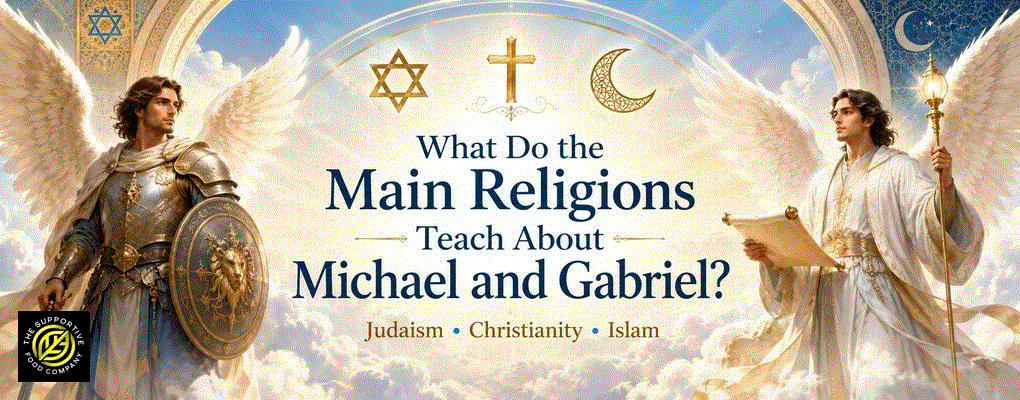
 Michael and Gabriel are mainly Abrahamic figures. They matter most in Judaism, Christianity, and Islam. In religions such as Hinduism, Buddhism, Jainism, and Sikhism, they are not normally part of the central teaching, although those traditions may have other heavenly beings, devas, spirits, or messengers.
 Christianity
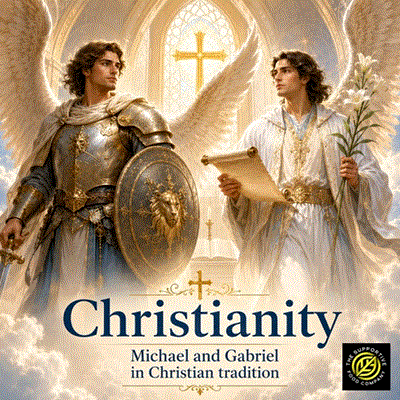
In Christianity, Michael is usually understood as the warrior archangel: the defender of God’s people and the leader of the heavenly host against evil, especially in Revelation 12. He is also connected with Jude 1:9 and Daniel. Catholic, Orthodox, Anglican, Lutheran, and many other Christians honour him as Saint Michael the Archangel.
Gabriel is primarily the messenger of God. In Christian Scripture he appears in Luke’s Gospel, announcing the birth of John the Baptist to Zechariah and the birth of Jesus to Mary. Christian tradition therefore strongly associates Gabriel with revelation, announcement, and the Incarnation.
Christian practice differs by denomination. Catholics celebrate Michael, Gabriel, and Raphael together on 29 September; Orthodox Christians celebrate the Synaxis of the Archangels, including Michael and Gabriel, on 8 November. Orthodox sources also stress that angels are not worshipped as gods, but properly honoured as servants of God.
A minority of Christian groups interpret Michael differently. Jehovah’s Witnesses, for example, identify Michael with Jesus in his heavenly role, while this is not the mainstream Catholic, Orthodox, or Protestant view.
 Judaism
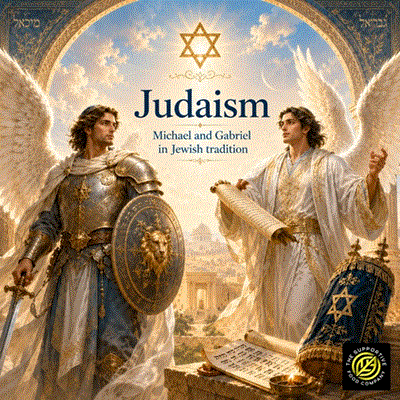
In Judaism, Michael is often seen as a great protecting angel, especially linked with Israel. In the Book of Daniel, Michael appears as “one of the chief princes” and as a heavenly protector. Jewish tradition also links Michael with mercy, kindness, and protection. Gabriel is also named in Daniel, where he explains visions to Daniel, and later Jewish teaching often contrasts Gabriel with Michael: Michael is associated with kindness or water, Gabriel with severity, judgment, or fire.
Jewish sources also often place Michael and Gabriel among the chief angels around God’s throne. The Jewish Encyclopedia says Gabriel is mentioned with Michael in Daniel and that the two are often grouped with other great angels such as Raphael and Uriel.
 Islam
Islam
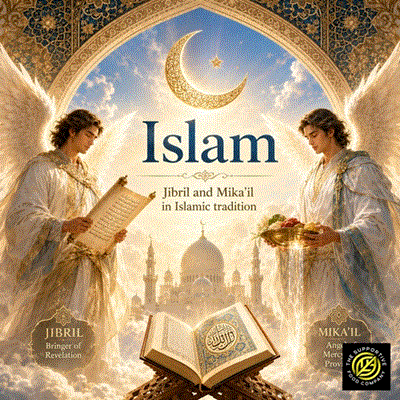
In Islam, Gabriel is Jibril and Michael is Mika’il. Jibril/Gabriel has a central role because Muslims believe he brought the Qur’an to the Prophet Muhammad by Allah’s command. Qur’an 2:97 directly says Gabriel revealed the Qur’an to Muhammad’s heart by Allah’s will.
Mika’il/Michael is mentioned by name in Qur’an 2:98 alongside Gabriel. Islamic teaching generally sees him as one of the great angels, often associated in later teaching with mercy, rain, provision, and spiritual or material help.
Other major religions
In Hinduism, Buddhism, Jainism, and Sikhism, Michael and Gabriel are not normally central named figures. They belong specifically to the Jewish-Christian-Islamic angelic tradition. Those religions may speak of divine beings, devas, bodhisattvas, heavenly realms, or spiritual messengers, but Michael and Gabriel themselves are not standard figures in their main scriptures or worship.
In one line
Michael is usually the protector/warrior angel; Gabriel is usually the messenger/revelation angel. Judaism, Christianity, and Islam all honour them as servants of God, not as gods themselves.