
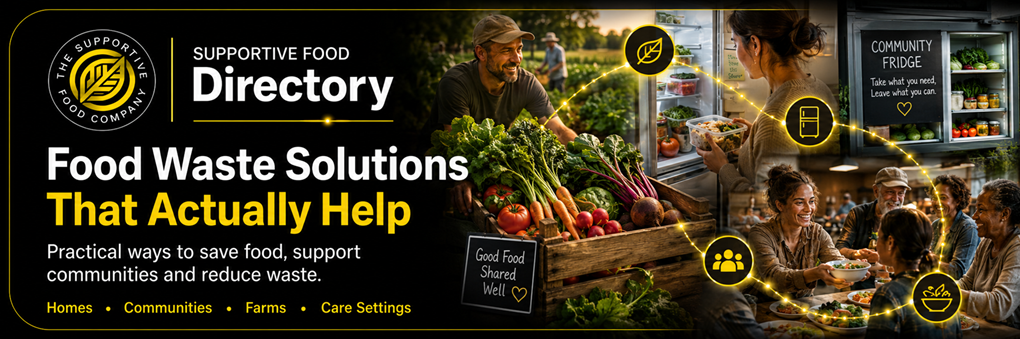
Food Waste Solutions That Actually Help
Most of us have opened the fridge and found a bag of salad that has gone slimy, leftovers we forgot about, or fruit that suddenly seems past its best. It can feel like a small everyday annoyance, but when the same thing happens across homes, farms, shops, hospitals, care settings and supply chains, food waste becomes much bigger than a kitchen problem.
Food waste affects household budgets, farmers, charities, community groups, health and wellbeing, and whether good food reaches people who need it most.
It can also feel deeply uncomfortable. Many families are trying to stretch their food budget. Some people are skipping meals. Growers are working with tight margins and unpredictable weather. At the same time, perfectly edible food is still being lost or thrown away.
The answer is not to make people feel guilty. It is to find food waste solutions that are practical, fair and realistic for how people actually live.
Why food waste is a bigger problem than it first appears
It is easy to blame food waste on people shopping without a plan, cooking too much or misunderstanding food labels. Those things can play a part, but they are only one part of the story.
Food waste can happen at many stages. Crops may be left in fields because they do not meet cosmetic standards. Small producers may lose out when orders change at short notice. Shops may reject food that looks imperfect but is still perfectly good to eat. Large kitchens may over-cater because they are trying to avoid running short.
And at home, life is not always predictable. Someone living with illness, fatigue, stress or caring responsibilities may buy food with good intentions and then simply not have the energy, appetite or time to prepare it.
That is why food waste needs to be treated as a systems issue, not just a personal failing. Different causes need different solutions.
Food waste solutions at home should feel doable
The best household tips are the ones people can actually keep doing. Nobody needs a perfect fridge, a perfect meal plan or a perfect routine. Small, steady changes are often much more useful than trying to overhaul everything at once.
Shop for the week you are really having
A lot of food gets wasted because we shop for the week we hope we will have. We imagine home-cooked meals every night, packed lunches ready to go, and fresh vegetables used up neatly by the weekend.
Real life is often different. There may be appointments, school runs, fatigue, sudden changes in appetite, work pressure, caring responsibilities or days when cooking simply feels like too much.
A more honest shopping plan can help. That might mean buying fewer highly perishable foods, choosing loose fruit and vegetables instead of large packs, or keeping frozen vegetables on hand alongside fresh ones.
Frozen food can be especially helpful for people managing low energy, illness or unpredictable mealtimes. It takes away some of the pressure while still making it easier to eat well.
Understand date labels without taking unnecessary risks
Food labels can be confusing, and that confusion leads to a lot of avoidable waste.
As a simple guide, “use by” dates are about safety and should be taken seriously. “Best before” dates are usually about quality, so food may still be fine after that date if it has been stored properly and shows no signs of spoilage.
At the same time, food safety matters. Extra care is sensible for older adults, pregnant people, young children, and anyone with a weakened immune system. Reducing waste should never mean taking risks with health.
The aim is balance: not fear, not carelessness, but informed judgement.
Make your fridge easier to use
A fridge can either help reduce waste or hide food until it is too late.
Try keeping the things that need using first at eye level. Clear containers can make leftovers easier to spot. A small “eat first” area or shelf can be surprisingly useful. Even one simple reminder can stop good food from being forgotten.
It also helps to plan one or two flexible meals each week that can use up what is already in the house. Soup, omelettes, curries, stews, traybakes and pasta dishes can all work well for this.
These ideas are not glamorous, but they are practical — and practical is what works.
Community food waste solutions can support food access
Some of the best food waste solutions happen when people work together.
Community fridges, surplus food projects, shared cooking groups, local growing networks and food redistribution schemes can all help move good food to people who will value and use it.
This matters because food waste and hunger often exist side by side. When safe, edible food is redirected quickly and respectfully, communities benefit in two ways: less food is wasted, and more people can access food.
But redistribution should not be treated as the whole answer. It is helpful, but it does not replace the need for fair incomes, fair food pricing, and stronger local food systems.
Redistribution works best when people are connected
Surplus food is not always easy to move. A box of fresh produce is only useful if someone can collect it, store it safely and pass it on in time.
That means food waste solutions are not just about logistics. They are also about relationships.
Farmers, independent producers, community groups, volunteers, charities, health-related organisations and local food projects can all play a part. When those people can find and trust each other, good food has a much better chance of reaching the right place.
This is where directories, local networks and mission-led platforms can help. They make it easier for people doing useful work to connect instead of staying isolated.
Farms and producers need fairer options for surplus food
Food waste on farms is often less visible than food waste in homes, but it matters just as much.
Crops can be left unharvested because the cost of labour is too high, because an order has changed, or because the produce does not look the way buyers expect. Food can be rejected for being the wrong shape, size or appearance, even when it is still nutritious and good to eat.
For small and ethical producers, this is not just wasteful. It can be financially and emotionally draining.
Consumers can help by supporting “wonky veg” schemes, buying directly from producers where possible, and being more open to food that looks natural rather than perfect. But bigger buyers also need to play their part.
Schools, hospitals, care settings, local authorities, shops and caterers can all help by buying more seasonally, accepting natural variation, and valuing nutrition and fairness over perfect appearance.
Surplus food can sometimes be turned into soups, sauces, preserves, frozen meals or other useful products. But not every farm has the facilities, time or permissions to do this alone. Local partnerships can make a big difference.
The strongest food systems create several good routes for edible food before it becomes animal feed, compost or waste.
Institutions waste food in different ways
Hospitals, care homes, schools and large catering settings face different challenges from households.
They need to think about safety, nutrition, dignity, different dietary needs, unpredictable attendance and the risk of not having enough food available. Waste can happen because menus are too rigid, portions are too large, meals are served at the wrong time, or people are not well enough to eat what is offered.
This is especially important in healthcare and care settings. Illness can affect appetite, taste, swallowing, energy and treatment tolerance. A meal may look nutritionally balanced on paper but still come back untouched if it does not meet the person’s real needs at that moment.
Reducing waste in these settings is not only about saving money. It is also about care.
More flexible portions, better menu planning, protected mealtimes, good communication with patients and carers, and respect for cultural and medical needs can all help.
The best food waste solutions prevent waste first
It is always good to see edible food rescued and reused, but prevention is even better.
The most helpful approach is simple:
First, try to prevent edible food becoming surplus.
Next, redistribute safe surplus food to people.
Then, where appropriate, use what remains for animals.
Finally, compost what cannot be eaten or reused.
Composting has value, but it should not become a way of ignoring the loss of good food earlier in the chain. A composted carrot is better than a carrot in landfill, but a carrot eaten by someone who needs it is better still.
Of course, there are trade-offs. Very tight systems may reduce visible waste but struggle when demand suddenly changes. Keeping extra food available can prevent shortages but may create leftovers. The right answer depends on the setting.
That is why practical food waste solutions need flexibility, not one-size-fits-all advice.
What real progress looks like
We do not need to panic about every stale slice of bread or every carrot peeling. We need steady habits, fairer systems and better cooperation.
Progress looks like households shopping in a way that fits real life. It looks like growers being paid fairly for edible produce. It looks like hospitals, schools and care settings serving food that people can actually eat. It looks like communities building local routes so good food is shared before it is lost.
Food is never just a product on a shelf. It is nourishment, care, labour, land, culture and health all at once.
When we stop treating food waste as a private embarrassment and start seeing it as a shared challenge, better answers become possible.
Start where you are. Use what you can. Support the people already doing good work. Every meal saved is a small act of care — for people, for producers and for the wider food system.