
Regenerative farming: A field can look productive and still be running on borrowed time. Thin soils, fewer insects, rising input costs and stressed farm businesses rarely make it onto a supermarket label, yet they shape the food that reaches our plates. That is why the regenerative farming future matters far beyond agriculture. It sits at the meeting point of public health, rural resilience, ethical access to nutritious food, values driven investment, and the kind of food system we leave to the next generation.
For many people, regenerative farming is presented as a hopeful answer to a failing model. That hope is real, but it needs grounding. Regenerative farming is not a magic label and it is not one fixed method. It is better understood as an approach that works with living systems rather than against them – aiming to restore soil health, improve biodiversity, reduce reliance on synthetic inputs, strengthen water retention and, in many cases, improve the long-term resilience of farms.
 What the regenerative farming future could change
The real significance of a regenerative farming future is that it asks a wider question than yield alone. It asks whether food can be produced in a way that protects the ecological base it depends on while also serving human wellbeing. For patients, carers and families already thinking carefully about food and health, that question is not abstract. Soil quality, farming practices and crop diversity all shape the nutritional landscape, even if the relationship is not always simple or immediate.
Health is influenced by far more than whether a carrot is grown on a regenerative farm. Income, housing, stress, access to fresh food and the wider commercial food environment matter enormously. Still, the farming model behind our food system affects what is grown, how it is grown and who can afford to keep producing it. If farmers are trapped by debt, volatile commodity markets and expensive chemical inputs, communities become more vulnerable too.
A regenerative approach can help shift that pressure. Cover crops, diverse rotations, reduced tillage, integrating livestock carefully, compost use and agroforestry can all improve the life of the soil and reduce erosion. Over time, these practices may lower dependence on purchased inputs and make farms less exposed to shocks such as drought, floods and price spikes. That matters for ethical food security, but it also matters for dignity. A resilient farm is more able to keep feeding people.
Regenerative farming future and public health
Public health conversations often begin too late, once disease is already established. A fairer food system starts earlier – with how land is managed, which foods are prioritised and whether nourishing food is accessible to ordinary households. The regenerative farming future belongs in that conversation because agriculture is not separate from health. It is one of its foundations.
This does not mean every regenerative product is automatically healthier, nor that a farm transition will solve diet-related illness on its own. It does mean that farming practices influencing soil organic matter, water quality, pesticide use and crop diversity are public-interest issues, not private technical details. When a food system degrades land, concentrates power and favours ultra-processed volume over nourishment, the health costs do not disappear. They are simply carried elsewhere – by the NHS, by carers, by low-income families and by future generations.
For people living with cancer, diabetes, heart disease or inflammatory conditions, food choices often come with emotional, financial and practical strain. A better farming model should not become another premium lifestyle badge available only to the comfortable. If regenerative farming is to have real social value, it must connect to affordability, local supply, fair wages and equitable access. Otherwise, the language of renewal rings hollow. More info
Soil is not a niche issue
Healthy soil stores water, cycles nutrients, supports microorganisms and helps farms cope with weather extremes. Those functions sound technical, but they influence food prices, crop stability and environmental quality. When soil is depleted, production often becomes more dependent on external inputs. When soil is cared for, farms have a better chance of staying productive without escalating ecological damage.
That makes soil a public good. It deserves the same seriousness we give to clean air or safe drinking water. A regenerative future asks us to treat soil not as inert dirt beneath a crop, but as living infrastructure. More info
The hard truths behind the Regenerative promise
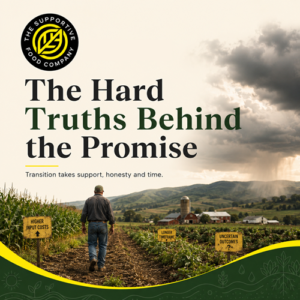 There is a tendency to speak about regenerative farming as though the transition were straightforward. It is not. Farmers face real barriers: uncertain markets, tenancy constraints, lack of technical support, upfront costs, labour pressures and policy frameworks that still reward scale and short-term output more readily than ecological repair.
Results also vary by region, soil type, weather, enterprise model and management skill. Reduced tillage may work well in one system and create weed or pest challenges in another. Livestock integration can help nutrient cycling on some farms, but poorly managed grazing can damage habitats and soil structure. The details matter.
There is also the risk of greenwashing. As regenerative language becomes commercially attractive, some businesses may use it loosely, with little transparency or measurable change. That is bad for farmers doing the difficult work properly, and it is unfair on consumers trying to make informed choices. Credibility depends on honesty, context and a willingness to discuss trade-offs rather than selling perfection.
A just and equitable transition matters
If the regenerative farming future is serious about fairness, farm workers, smallholders and lower-income households must be part of the picture. It cannot be designed around large businesses alone, nor around consumers with plenty of disposable income. Public policy, local procurement, community food partnerships and better routes to market all matter here.
Independent farmers often carry the burden of change while operating on tight margins. Asking them to restore landscapes without fair prices or practical backing is not reform. It is offloading responsibility. A just transition means shared effort and shared investment. More info
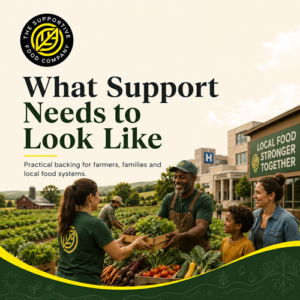 What support needs to look like
If we want regenerative farming to move from encouraging case studies to meaningful system change, support has to be practical. Farmers need stable incentives during transition periods, especially when short-term yields may fluctuate. They need access to peer learning, trusted agronomic advice, flexible finance and routes to sell food at prices that reflect real value rather than distorted market expectations.
Consumers need better food literacy, but they also need realistic options. Telling families to buy better while leaving them with poor local provision and rising living costs is not enough. Schools, hospitals, care settings and local authorities can play a stronger role by sourcing from producers using responsible methods where budgets and infrastructure allow. Done well, procurement can connect land stewardship with community nourishment.
This is where mission-led platforms such as Supportive Food Directory have a role to play. Connecting producers, patients, carers and health-conscious households helps close a gap that the mainstream food system often ignores. People do not only need products. They need trusted pathways between growing, eating, healing and community support.
What consumers can reasonably ask
People often want a simple rule for buying well, but food systems rarely offer one. Rather than chasing perfect labels, it is more useful to ask better questions. Is the producer transparent about soil, biodiversity and inputs? Are they building local resilience? Are they treating regeneration as a long-term practice rather than a marketing phrase? And just as importantly, is this food accessible, or only available to a narrow market?
Supporting regenerative farms can mean buying direct when possible, joining veg box schemes, using local markets, asking retailers tougher questions and backing policies that reward land care rather than extraction. Yet individual action has limits. Systemic change still requires political will, public investment and stronger regional food infrastructure. More info
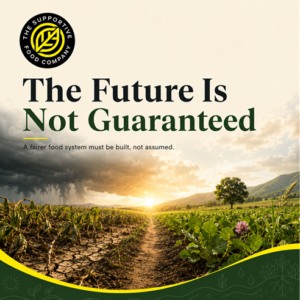 A Regenerative future is not guaranteed
There is no automatic path to a regenerative farming future. Industrial pressures remain powerful, land ownership remains unequal and many farming families are under strain. Climate disruption is already testing every model we have.
But the case for change is stronger now because the old bargain is breaking down. Cheap food is not truly cheap when soils erode, rivers are polluted, farmers leave the land and communities struggle to access nourishing meals.
Regeneration, at its best, offers a different bargain.
It says food production should restore more than it depletes. It says resilience matters as much as volume. It says the health of land and the health of people are linked, even when the policy world treats them separately.
That vision will only mean something if it stays rooted in justice. A future worth building is one where farmers can make a decent living, patients and families can afford nourishing food, and the land itself is given a chance to recover. The work is slower than a slogan and harder than a trend, but it is work that can still reshape what feeding one another looks like.
Regeneration, at its best, offers a different bargain
A regenerative future asks food production to restore more than it depletes. It values resilience as well as volume, and recognises that the health of people and land cannot be separated.