
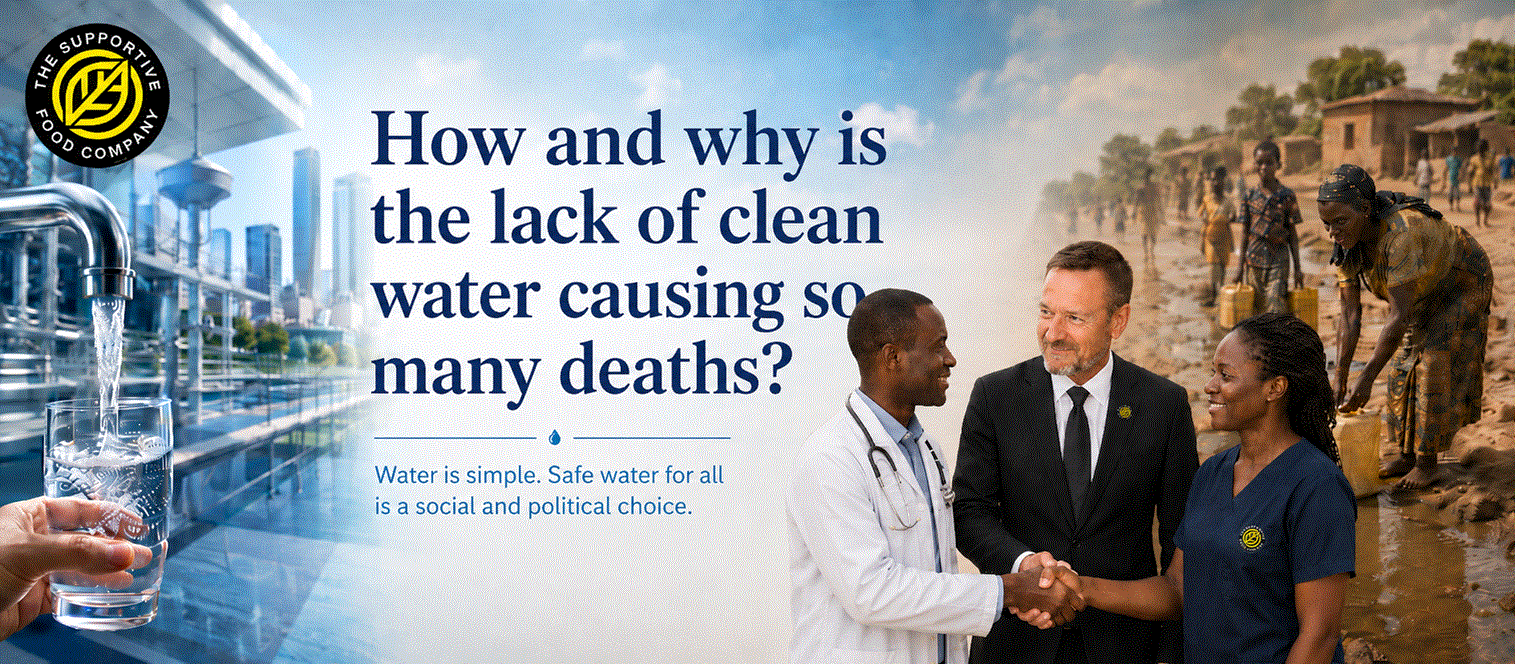
Why is the lack of clean water causing so many deaths?
The larger divide is not simply between modern nations and poor nations as one might think. It is between people whose basic needs are protected by functioning public systems and people who have been left outside them.
Water itself is simple. Providing safe water continuously, to everyone, is a social and political choice and an ethical investment decision.
As recently as 2024, around 2.1 billion people still lacked safely managed drinking water, despite enormous global wealth and well-understood technology. More than 100 million people were still collecting drinking water directly from rivers, lakes and other surface sources.
1. Why do people still suffer or die from unsafe water in modern, wealthy nations?
In wealthy countries, the problem is rarely that the nation lacks money, knowledge or water-treatment technology. It is usually that certain communities are overlooked.
People may be affected because of:
- ageing pipes and water infrastructure;
- contamination from lead, chemicals, sewage or agricultural pollution;
- poorly maintained private wells;
- homelessness or insecure housing;
- remote rural communities;
- neglected Indigenous or minority communities;
- floods, storms and other emergencies;
- failures in monitoring, regulation or local government;
- poverty that makes bottled water, repairs or alternative supplies unaffordable.
Even in the United States, the CDC estimates that at least 1.1 million people become ill each year from germs in drinking water.
So a wealthy country can have excellent water nationally while allowing particular towns, neighbourhoods or vulnerable groups to experience unsafe water.
That is not mainly a failure of science.
It is a failure of equal provision, maintenance and accountability.
2. Why is the problem so much greater in impoverished nations?
Here poverty becomes both the cause and the consequence.
An impoverished country may have:
- too little public money to construct nationwide water systems;
- a small tax base;
- heavy national debt;
- rapidly growing informal settlements;
- scattered rural populations that are more expensive to reach;
- weak local authorities or water utilities;
- war, displacement or political instability;
- drought, flooding and climate pressures;
- corruption or poor allocation of funds;
- insufficient laboratories, engineers and trained maintenance staff;
- inadequate sanitation contaminating otherwise usable water sources.
Yet poverty is not simply “a lack of money.” It can become a trap.
Unsafe water causes illness. Illness prevents adults from working and children from attending school. Families spend scarce money on medicine, bottled water or transport. Women and children may spend hours collecting water instead of learning, earning or caring for others. Poverty then deepens—and the community becomes even less able to fund safe infrastructure.
Unsafe water and inadequate sanitation are linked to cholera, diarrhoea, typhoid, dysentery, hepatitis A and other preventable diseases. WHO estimates that better water, sanitation and hygiene could prevent as many as 1.4 million deaths each year.
“But investment could be so easy…”
In many places, yes. That is what makes the situation so difficult to accept.
A borehole, protected spring, rainwater system, filtration unit, local treatment plant or piped community supply can transform thousands of lives.
But there is an important distinction:
A water pump is an object. A safe water supply is a continuing service.
Building something is often easier than ensuring that it still works five, ten or twenty years later.
A reliable system also needs:
- protected water sources;
- treatment and regular testing;
- pumps, pipes and storage;
- electricity or another power source;
- trained local operators;
- spare parts;
- repairs and continuing maintenance;
- safe toilets and sewage management;
- transparent management;
- affordable access for the poorest households.
Too many projects fund the photograph—the new well, pump or treatment unit—but not the less visible work of maintaining it year after year.
Nevertheless, investment in water is extraordinarily worthwhile. WHO economic analyses have found strong returns through lower healthcare costs, greater productivity, saved time and fewer premature deaths.
The deeper answer
Perhaps the uncomfortable truth is:
People are not dying because humanity does not know how to provide clean water. They are dying because poverty determines whose needs receive investment, whose infrastructure is maintained and whose suffering attracts political attention.
We can construct enormous cities, data centres, airports, weapons systems and global communications networks. Providing safe drinking water is technically achievable.
The obstacle is often not the absence of resources.
It is the failure to treat clean water as an unconditional human necessity rather than a service whose quality depends upon wealth, location or political influence.
And perhaps the word “impoverished” is important because it describes a process—not merely a condition.
Many communities are not naturally poor. They have been left without investment, excluded from opportunity, weakened by debt or conflict, or repeatedly placed last in the queue for essential infrastructure.
That is why clean water belongs naturally within the wider Supportive Food vision. Safe food, nutrition, farming, health and clean water cannot truly be separated.
Home | Food | Facebook | Other sources | Investors | Editors | Contact