
Organic Farming | Farming Practices | Today’s Food System | Advantages & challenges | A Message to Farmers | Farming benefits
Ecological Advantages of Organic Farming
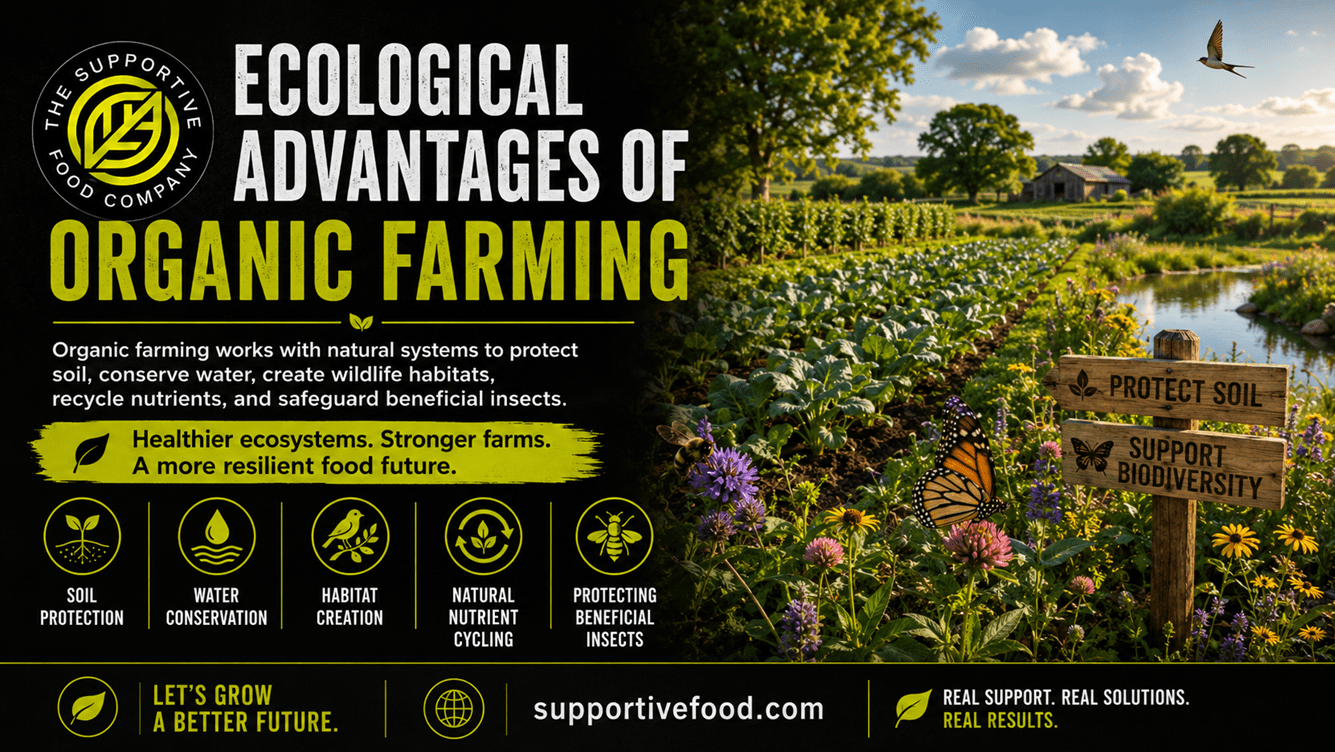
Organic farming offers several ecological advantages because it works closely with natural systems.
Soil Protection
Organic methods help reduce soil erosion by keeping the ground covered with crops, mulch, or plant residues. This protects topsoil from being washed or blown away.
Water Conservation
Soil rich in organic matter can hold more water, helping crops survive dry periods and reducing the need for irrigation. Cleaner farming methods also reduce the risk of polluting water sources.
Habitat Creation
Organic farms often include features such as trees, hedges, ponds, wild margins, and mixed planting areas. These habitats support birds, insects, small mammals, amphibians, and beneficial organisms.
Natural Nutrient Cycling
Organic farming recycles nutrients through compost, manure, plant residues, and cover crops. This reduces dependence on external synthetic inputs and helps create a more circular farm system.
Reduced Impact on Beneficial Insects
By avoiding broad-spectrum synthetic pesticides, organic farms can better protect beneficial insects that help with pollination and natural pest control.
Challenges of Organic Farming
Although organic farming has many benefits, it also comes with challenges.
Lower Yields in Some Conditions
Organic farms may produce lower yields than conventional farms, especially during transition periods or in systems where pests, diseases, or soil fertility are difficult to manage. However, results vary depending on crop type, region, climate, and farming skill.
Higher Labour Requirements
Organic farming often requires more manual work, especially for weed control, compost management, crop monitoring, and livestock care. This can increase production costs.
Certification Costs and Rules
Farmers who want to sell certified organic products must usually follow strict standards and undergo inspections. Certification can be expensive or complicated, especially for small farmers.
Pest and Disease Pressure
Without synthetic pesticides, organic farmers need strong prevention strategies. If pests or diseases become severe, control options may be more limited.
Transition Period
Land usually needs a transition period before it can be certified organic. During this time, farmers may face higher costs while not yet receiving organic price premiums.
Market Access
Some organic farmers struggle to reach customers willing or able to pay higher prices. Distribution, storage, and marketing can also be difficult in some regions.
Knowledge and Training
Organic farming requires a deep understanding of soil, ecology, crop cycles, pests, weather, and farm management. Farmers may need training and support to make the system successful.
Organic Farming and the Future of Food
Organic farming is an important part of the global conversation about sustainable agriculture. It offers practical ways to protect soil, reduce pollution, support biodiversity, and produce food with greater respect for natural systems.
However, organic farming is not a single solution to every food system challenge. It works best when combined with good science, local knowledge, fair markets, responsible consumption, and supportive policies.
As climate change, soil degradation, water scarcity, and biodiversity loss become more serious, organic farming provides valuable lessons for the future: healthy soil matters, biodiversity matters, and farming must work with nature rather than against it.
Conclusion
Organic farming is a sustainable approach to agriculture that focuses on soil health, ecological balance, animal welfare, and reduced chemical use. Its methods include composting, crop rotation, cover cropping, natural pest control, and responsible livestock management.
The benefits of organic farming include healthier soils, cleaner water, greater biodiversity, improved pollinator protection, and long-term environmental resilience. At the same time, organic farming faces challenges such as lower yields in some cases, higher labour needs, certification costs, and pest management difficulties.
Overall, organic farming plays a vital role in building a more sustainable, balanced, and environmentally responsible food system for the future.
In this section
- Organic Farming – what is it?
- Common Organic Farming Practices
- Organic Farming in Today’s Food System
- Advantages & challenges of Organic Farming (This page)
- A Message to Farmers Using Chemical Inputs
Home | Food | Facebook | Other sources | Editors
Sources:
- Organic farming | Definition, History, Methods, Practices, & Benefits | Britannica An in-depth article from Britannica covering the definition, history, methods, practices, and benefits of organic farming, including its ecological advantages and challenges.
- Organic Farming | US EPA The U.S. Environmental Protection Agency’s overview of organic farming, detailing its practices, benefits, and the National Organic Program.
- What is Organic Farming? | Soil Association An explanation from the Soil Association about organic farming, emphasizing its holistic approach to soil health, ecosystems, and human well-being.
- Organic Farming | USDA The U.S. Department of Agriculture’s resources on organic farming, including data, research, and support for organic producers.
- Organic food | Definition, Policies, & Impacts | Britannica An article from Britannica discussing the definition, policies, and impacts of organic food, including its production methods and market growth.
