
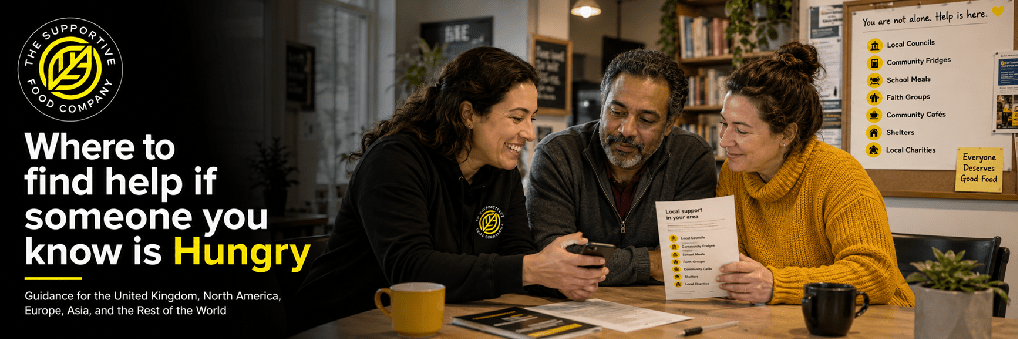
Where to find help if someone you know is Hungry
Helpful suggestions, especially if someone you know has no internet. Download a .pdf
Hunger can happen for many reasons: loss of income, illness, homelessness, family breakdown, travel problems, migration, disaster, or simply the rising cost of living. Whatever the reason, needing food is not a personal failure. Help is often available from more places than people realise.
Food banks and embassies are included below, but they are not the only options. If you need food today, use clear wording when asking for help: “I have no food today. Where can I get a meal or emergency food parcel?” If you have children, are pregnant, elderly, disabled, unwell, homeless, fleeing violence, or stranded away from home, say this too, because some services can respond faster when there is extra risk.
In the United Kingdom
In the UK, your first practical route is often your local council. Councils may be able to help with emergency food, food vouchers, crisis grants, school holiday food support, or referrals to local charities. Search for your local council’s cost-of-living, crisis support, welfare assistance, or household support page.
Food banks are still important, but they work differently from place to place. Some need a referral from Citizens Advice, a GP, school, social worker, housing officer, health visitor, local charity, or religious organisation. Others are independent and may allow people to attend directly. If one food bank says no, ask where else you can go.
Other useful places include community fridges, social supermarkets, food pantries, soup kitchens, churches, mosques, Sikh gurdwaras, temples, Salvation Army centres, homelessness day centres, refugee charities, community cafés, and local mutual aid groups. Sikh gurdwaras are especially worth knowing about because many offer langar, a free vegetarian community meal open to everyone, regardless of religion or background.
Families should also check free school meals, holiday food programmes, breakfast clubs, and Healthy Start or Best Start Foods schemes. If you are pregnant or have a young child, ask your midwife, health visitor, GP surgery, children’s centre, or local family hub about food help.
If you are homeless or sleeping rough, contact your council’s homelessness team, a day centre, Shelter, Crisis, the Salvation Army, local churches, or street outreach services. If you are a refugee, asylum seeker, migrant, or have no recourse to public funds, ask local refugee charities, British Red Cross services, law centres, community groups, and faith organisations what food help is available.
In North America
In the United States, call 211 to be connected with local food, housing, health, and social support. You can also contact the National Hunger Hotline, local food pantries, soup kitchens, shelters, churches, mosques, synagogues, gurdwaras, community centres, and local government social services. Food banks and pantry networks can often tell you where to get food today.
Government programmes may also help. SNAP can help eligible households buy food. WIC supports pregnant people, new parents, infants, and children under five. School meals, summer meals, senior nutrition programmes, Meals on Wheels, and emergency food programmes may also be available. If there has been a disaster, ask about emergency food benefits and disaster relief.
In Canada, call 211 where available or use 211 online to find local food programmes, community meals, shelters, food banks, and social services. Food Banks Canada can help people locate food banks, but smaller local food programmes may not always appear on national lists, so also ask local community centres, municipal offices, churches, gurdwaras, Indigenous community organisations, settlement agencies, and shelters.
In Mexico, the Caribbean, and other parts of North America, look for local social development offices, municipal welfare services, churches, Catholic charities, Red Cross branches, migrant shelters, community kitchens, food banks, and neighbourhood mutual aid groups. If you are travelling and stranded without money, contact your embassy or consulate. They may not provide ongoing food, but they may be able to contact family, advise on emergency funds, or guide you to local help.
In Europe
Across Europe, the best starting point is usually the local municipality, town hall, social welfare office, or community services department. Ask specifically about emergency food, social assistance, meal vouchers, family support, housing support, and local charities.
Food banks operate in many European countries, often through national food bank networks and local charities. There are also community kitchens, social supermarkets, solidarity fridges, church meal services, Red Cross or Red Crescent branches, Caritas services, Salvation Army centres, migrant support centres, refugee charities, and homeless day centres. In some cities, community cafés and “pay what you can” meals are available.
If you are an EU resident, a refugee, an asylum seeker, a student, a seasonal worker, or a migrant worker, the right place to ask may differ. Students should contact their university welfare office or student union. Migrants and asylum seekers should contact recognised refugee support organisations, legal advice centres, shelters, or local Red Cross services. Families should ask schools, social workers, and child welfare services about meal support.
If you are abroad and cannot access money, contact your embassy or consulate. They may not act like a food charity, but they can often explain emergency options, contact relatives, or advise on returning home.
In Asia
Asia is very diverse, so food help varies greatly by country and city. Start with local government welfare offices, village or municipal leaders, social workers, hospitals, community centres, and recognised charities.
Religious and community food help can be especially important. Sikh gurdwaras may offer langar, a free community meal. Temples, mosques, churches, monasteries, and other faith communities may run meal services, food distributions, or emergency help, especially during festivals, disasters, or local hardship.
Food banks and food rescue organisations exist in many Asian cities. Examples include food bank networks, surplus food redistribution groups, community fridges, and volunteer meal-distribution groups. In Singapore and Hong Kong, there are established food rescue and food support networks. In India and some neighbouring countries, volunteer organisations and community kitchens may distribute cooked meals or surplus food.
If you are a refugee, displaced person, migrant worker, or affected by conflict or disaster, contact UNHCR, IOM, Red Cross or Red Crescent societies, local NGOs, shelters, or official aid centres where they are operating. If you are a traveller stranded without food or money, contact your embassy or consulate for guidance.
Rest of the World
In Africa, Latin America, the Middle East, Oceania, and island nations, the best options depend on local systems. Start with local government welfare offices, community leaders, churches, mosques, temples, Red Cross or Red Crescent branches, local charities, shelters, food banks, schools, clinics, and community centres.
In disaster zones or conflict areas, emergency food may be provided through the World Food Programme, Red Cross or Red Crescent, World Central Kitchen, local NGOs, UN agencies, government relief centres, or community kitchens. Aid is often distributed through registered local partners, so ask local officials, shelters, clinics, or recognised charities where distribution is happening.
If you are a refugee, asylum seeker, internally displaced person, or stateless person, contact UNHCR or its local partners where available. If you are a migrant who wants help returning home or needs advice, IOM or local migrant support organisations may be able to advise. If you are overseas and stranded, contact your embassy or consulate.
Food banks are also present in many countries through local and international networks, but they may not always be called “food banks.” Search for terms such as food pantry, food parcel, community kitchen, free meals, social supermarket, surplus food, rescue food, meal centre, shelter meals, or emergency food aid in the local language.
How to ask for help
When contacting any organisation, keep your message simple:
“Hello, I need urgent food help. I do not have enough food today. Can you tell me where I can get a free meal, food parcel, food voucher, community kitchen, or emergency support near me?”
Add any important details:
“I have children.”
“I am pregnant.”
“I am elderly or disabled.”
“I have no cooking facilities.”
“I am homeless.”
“I am stranded away from home.”
“I have a medical condition or dietary need.”
“I do not speak the local language.”
“I do not have documents with me.”
A few safety tips
Use official organisations where possible. Be careful about giving personal documents, bank details, passwords, or immigration papers to unknown people online. If someone offers help privately, meet only in a safe public place and do not put yourself at risk.
Call ahead if you can, because opening hours and referral rules often change. Ask whether you need ID, proof of address, a referral, or an appointment. If you are turned away, ask: “Where else can I go today?”
Most importantly, do not wait until the situation becomes unbearable. Hunger affects health, mood, decision-making, and safety. Ask early, ask clearly, and ask more than one place. Help may be closer than you think.
Key source notes used for accuracy: UK local councils can provide help with food and essential costs, while Healthy Start and free school meals cover specific family needs. Community fridges in the UK are open-access, non-means-tested food-sharing spaces, and Salvation Army Food banks may offer food banks, lunch clubs, holiday meals, food parcels, pantries, or community supermarkets depending on local need. For North America, USAGov lists the National Hunger Hotline, 211, SNAP/WIC/emergency food routes, and local organisations; 211 Canada is a national route into community and social services, and Food Banks Canada provides a food bank finder. For Europe and wider global references, the EU’s ESF+/FEAD framework supports food and basic material assistance, FEBA links European food bank networks, the Global FoodBanking Network maps food banking across more than 50 countries, WFP works in over 120 countries and territories, and UNHCR uses cash assistance to help displaced people meet urgent needs.