
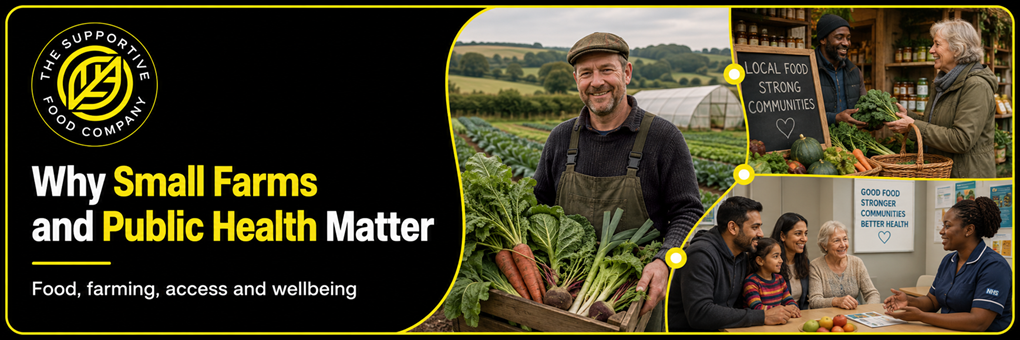
Why Small Farms and Public Health Matter
A community’s health can shift with something as ordinary as where its carrots, eggs or oats come from. Small farms and public health are often treated as separate issues – one belonging to agriculture, the other to hospitals and policy. In reality, they meet at the kitchen table, in school meals, in local high streets, and in the daily choices people make when managing illness, stretching a budget or trying to feed a family well.
For anyone living with cancer, diabetes, heart disease or other long-term conditions, food is never just fuel. It can support strength, symptom management and quality of life. That makes the structure of the food system a health issue, not a niche farming debate. When small farms are able to grow diverse, nourishing food and keep it circulating locally, the benefits can reach far beyond the farm gate.
The link between small farms and public health
Public health is shaped by the conditions that make health possible or difficult: income, housing, transport, education, access to care and access to decent food. Small farms sit within that picture because they can influence what food is available, how fresh it is, how far it travels and who gets to buy it.
This does not mean every small farm is automatically healthy, equitable or sustainable. Scale alone guarantees very little. But smaller farms are often better placed to grow varied crops, respond to local need and build direct relationships with the people they feed. That matters in a food environment where many households are surrounded by highly processed, aggressively marketed options while fresh, nutrient-dense food remains unevenly distributed.
In practical terms, a thriving network of small farms can support dietary diversity. Instead of depending on a narrow range of commodity crops, communities may gain better access to vegetables, pulses, fruit, eggs, dairy, herbs and traditionally grown foods. For people trying to improve fibre intake, reduce ultra-processed foods or eat in ways that support recovery and long-term health, that variety matters.
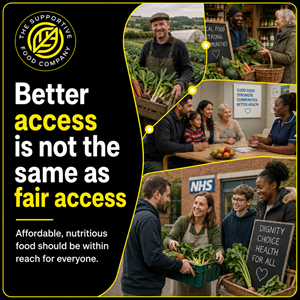 Better access is not the same as fair access
There is a temptation to romanticise local food. A farm shop full of beautiful produce may look like a public-health success story, but if prices are out of reach or transport is poor, access remains limited. Public health asks harder questions. Who can afford the food? Who can physically get to it? Who has the time, confidence and facilities to cook it?
This is where the conversation needs honesty. Small farms can strengthen local food resilience, but they often operate within the same unequal economy as everyone else. Many are under pressure from land costs, energy bills, supermarket pricing and labour shortages. Asking them to provide cheap food without wider policy support is not fair, and it will not solve hunger.
A more serious approach links farm viability with community access. That could mean procurement that favours local producers for schools and care settings, community veg schemes, culturally relevant produce grown for local populations, or partnerships with food charities and mutual aid groups. When this works well, it protects dignity on both sides: farmers are paid properly, and households are not forced to choose between nutrition and the gas meter.
Food quality, freshness and nutritional value
Freshness is not a moral badge, but it can make a real difference. Many foods from small farms reach consumers more quickly and spend less time in storage and transport. That can help with taste, texture and in some cases nutrient retention, especially for delicate produce.
The public-health value here is simple. Food that tastes better and cooks well is more likely to be eaten. For older adults, people with reduced appetite, and those recovering from treatment, that matters. A tomato with flavour or greens that are not limp and tired may sound modest, yet these details can affect whether someone manages a balanced meal at all.
There is also the question of trust. People often want to know how food was grown, whether animals were well kept, and what practices were used on the land. Direct relationships cannot replace regulation, and not every local producer is transparent. Still, shorter supply chains can make it easier for people to ask questions and make informed choices.
Why diversity on farms matters for human health
A food system built on uniformity tends to produce diets built on uniformity. Large-scale supply chains often reward standardisation, shelf life and visual perfection. Public health, however, benefits from diversity – in crops, in nutrients, in cooking traditions and in routes to market.
Small farms are often the places where unusual varieties, mixed production and seasonal eating remain possible. They may grow heritage vegetables, keep different livestock breeds, trial lower-input methods or serve communities overlooked by mainstream retail. This variety is not just charming. It can support soil health, broaden diets and keep regional food knowledge alive.
For communities with strong culinary traditions, access to familiar ingredients can also support cultural wellbeing. Health advice lands better when it respects identity rather than erasing it. Food justice includes the right to eat well in ways that feel recognisable and dignified.
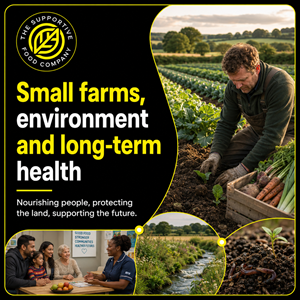 Small farms, environment and long-term health
No conversation about public health is complete without the environment. Air quality, water quality, soil condition and climate pressures all shape human wellbeing. Farming can damage these systems, but it can also help repair them depending on the methods used.
Small farms are not automatically low-impact, and large farms are not automatically harmful. It depends on management, landscape, infrastructure and incentive structures. Even so, many smaller producers work with more mixed systems, shorter supply chains or lower-volume production that may reduce some environmental burdens.
That matters because environmental harm becomes a health burden sooner or later. Polluted water, degraded soils and climate shocks do not stay on farmland. They affect food prices, crop reliability, infectious disease patterns and household stress. Public health should care not only about what food does in the body, but about whether the way we produce it undermines the conditions needed for future health.
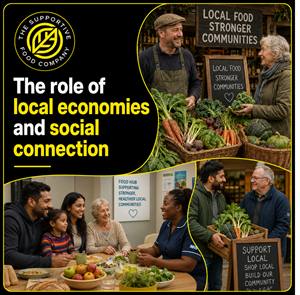 The role of local economies and social connection
Health is social. People fare better when communities have stable work, mutual support and places where relationships can form. Small farms can contribute to this in ways that are easy to miss if we look only at yield per acre.
They create local employment, support small processors and markets, and keep more value circulating regionally. They can become anchor points for volunteering, education and community growing. For children, visiting or learning from a farm can turn food from an abstract product into something living and shared. For adults who feel cut off from how food is produced, these connections can rebuild confidence and practical knowledge.
This is especially relevant when illness enters the household. Carers and patients often need straightforward, trustworthy routes to good food. Community-rooted producers can sometimes offer a level of responsiveness that anonymous supply chains cannot. At Supportive Food Directory, that link between producers, health needs and social fairness is central because food systems either support wellbeing or quietly undermine it.
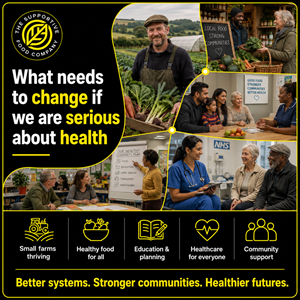 What needs to change if we are serious about health
If we want small farms and public health to strengthen one another, the answer is not nostalgia. It is structural support. Farmers need fair prices, secure access to land and protection from being squeezed out by a system that rewards volume over value. Communities need affordable, nearby food and practical support to cook and use it.
Healthcare, local government, educators and food organisers also need to stop treating nutrition as an afterthought. Prescriptions and procedures matter, but so do meals, food skills and supply chains. It should not be radical to say that a healthier population depends partly on whether good food is grown, distributed and made accessible with care.
This calls for joined-up thinking. A hospital discussing recovery nutrition, a council reviewing procurement, a school improving meals and a small grower seeking stable demand are not separate stories. They are part of the same public-health landscape.
The strongest food systems are not built on charity alone, and they are not built on market logic alone either. They are built when communities decide that decent food is part of decent healthcare, and that the people who grow it should be able to survive. If we keep that principle in view, supporting small farms becomes more than an ethical preference. It becomes a practical step towards a fairer, healthier society.