
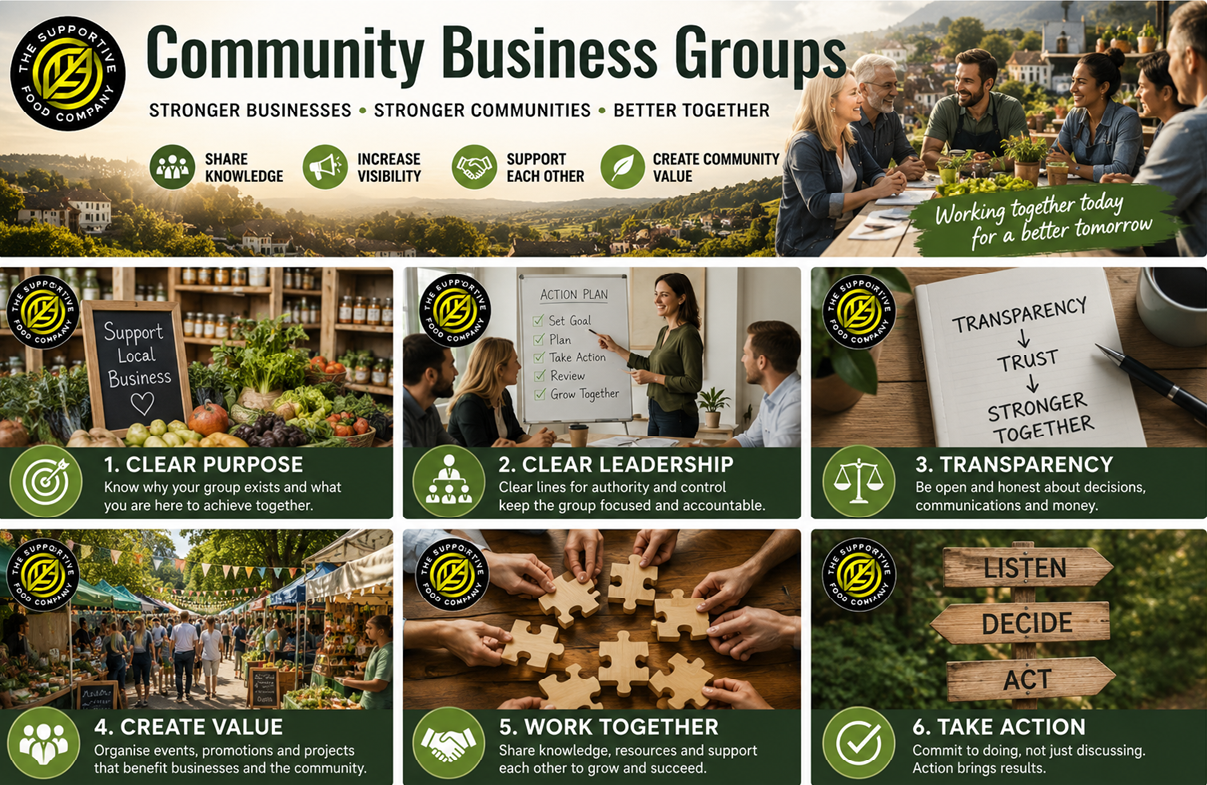
Community Business Groups
How Business Collaborations Can Help Communities
Basis: “We can do more together than we can do alone.”
This may be a group of local shops wanting to bring more people into a town centre. It may be farmers, food producers, cafés, wellbeing practitioners, community organisers, charities, educators, or ethical businesses wanting to support better food, better health, better local trade, and stronger communities.
At their best, community business groups create connection. They help small businesses share ideas, attract customers, solve practical problems, promote good work, and support local people. They can bring together producers, retailers, cafés, markets, growers, community groups, health-aware professionals, and customers who care about quality, fairness, sustainability, and trust.
But collaboration is not always easy. If not careful it can be a nightmare, leading to failure!
A business group can become useful, energetic, and trusted. It can also become slow, political, confusing, and exhausting if nobody knows who is responsible, who has authority, who controls money, or who makes final decisions.
The idea may be friendly and community-minded, but it still needs practical structure. A good business collaboration does not need to be complicated. It needs to be clear.
 Start with the purpose, not the group name
Before choosing a name, logo, committee, bank account, website, meeting venue, or launch event, ask one important question:
What are we trying to achieve together?
For example, a community business group might aim to:
- Promote local independent businesses.
- Help people find better food, local producers, and responsible wellbeing support.
- Support farmers, growers, shops, cafés, markets, and ethical suppliers.
- Create shared events, open days, food trails, talks, or local business showcases.
- Improve footfall in a high street, village, town, or local market.
- Share practical business knowledge between members.
- Create a trusted local directory of useful businesses.
- Support community projects through sponsorship, donations, or shared resources.
- Encourage responsible buying, local supply chains, and fairer food systems.
- Give small businesses a stronger collective voice.
A group with a clear purpose is easier to explain, easier to support, and easier to manage.
A useful test is this:
Can you explain the collaboration in one sentence?
For example:
“We are a local business collaboration helping people discover trusted food, farming, wellbeing, and community businesses in our area.” Or: “We connect ethical businesses, local producers, and community organisations so people can find better food, useful services, and practical local support.”
If the purpose is not clear, the group will drift. People will join with different assumptions, meetings will become unfocused, and decisions will become harder.
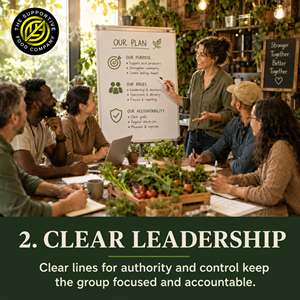 Clear lines are needed for authority and control
This is one of the most important points. A business collaboration can be friendly and open, but it still needs clear lines of authority and control. That does not mean one person behaves badly or ignores everyone else. It means people know who is responsible for what.
Every group should be able to answer:
- Who owns or controls the group name?
- Who controls the website, directory, social media, and email list?
- Who can approve new members?
- Who can remove a member if there is a serious problem?
- Who holds the money?
- Who approves spending?
- Who signs agreements?
- Who speaks publicly for the group?
- Who has final say if there is disagreement?
- Who is legally responsible if something goes wrong?
Without clear authority, groups become vulnerable to confusion, arguments, takeover attempts, personality clashes, and slow decision-making. Collaboration does not mean everyone controls everything.
A better model is often:
Listen widely. Decide clearly. Act responsibly.
People should be consulted. Members should feel respected. But final responsibility must sit somewhere. If nobody has authority, nobody is truly accountable.

Why business collaborations can be powerful
Business collaborations can be very positive when they are built on trust and practical value. Small businesses often face the same problems: visibility, costs, customer awareness, changing markets, online competition, staffing pressures, rent, regulations, and lack of time. A good group can help businesses feel less alone.
The positives can include:
1. Shared visibility
One small business may struggle to get noticed. Ten, twenty, or fifty businesses working together can create more public interest.
A shared directory, local map, social media campaign, market event, open day, or seasonal promotion can help customers discover businesses they might otherwise miss.
2. Stronger local identity
A community business group can help a place become known for something. That might be local food, organic produce, independent shops, ethical trade, creative businesses, sustainable living, health-aware services, farming links, cafés, markets, or community support.
When businesses work together, the whole area can become more attractive.
3. Shared knowledge
Business owners learn a great deal through experience. A group can allow members to share what works and what does not. This may include:
- Good suppliers.
- Local advertising ideas.
- Event experience.
- Website and directory advice.
- Social media tips.
- Food safety considerations.
- Customer service ideas.
- Grant or funding information.
- Lessons from mistakes.
This kind of practical knowledge is often more useful than theory.
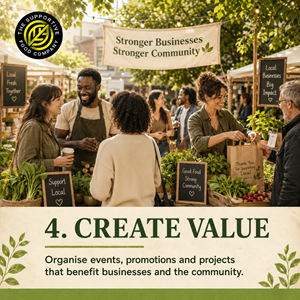
4. Better events
A single business may not be able to organise a successful event alone. A group can create something larger and more attractive.
Examples include:
- Local food fairs.
- Farm shop weekends.
- Independent business trails.
- Healthy living events.
- Talks and demonstrations.
- Seasonal markets.
- Producer showcases.
- Community meals.
- Charity fundraising days.
- Educational events with responsible speakers.
Events work best when they are useful, well-promoted, and realistic.
5. Mutual support
Small business can be lonely. Owners often carry stress quietly.
A well-run group can create encouragement, friendship, introductions, and practical help. It can also help businesses respond to local difficulties, such as roadworks, flooding, poor footfall, sudden closures, rising costs, or changes in customer behaviour.
6. More community benefit
Business collaborations can help communities when they go beyond self-promotion.
For example, businesses may support food banks, community gardens, farmers, carers’ groups, school projects, educational talks, local directories, or responsible food and wellbeing information.
This matters because good business is not only about selling. It is also about trust, service, and contribution.
 The negatives and risks
Business groups can also go wrong. This does not mean they should be avoided. It means they should be set up honestly. The common problems include:
1. Too much talking, not enough doing
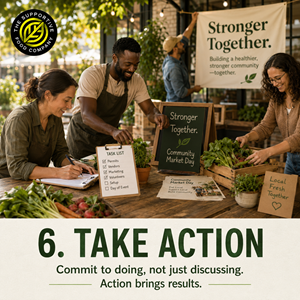
Some groups become meeting-heavy. People discuss ideas repeatedly but nothing practical happens. This often occurs when there is no clear leader, no agreed first goal, and no person responsible for action. A business group should not exist just to hold meetings. It should create useful outcomes.
2. Confused expectations
One person may think the group is for networking. Another may think it is for campaigning. Another may expect free advertising. Another may want political influence. Another may want a buying group. Another may want social events. If the purpose is not clear, disappointment follows.
3. Unequal contribution
In many groups, a few people do most of the work while others benefit. This creates resentment. Volunteers burn out. The group becomes dependent on one or two energetic people. A healthy group should be honest about who is doing the work and how they are supported.
4. Competition between members
Businesses may support each other, but they may also compete. Two cafés, two farm shops, two nutrition practitioners, two furniture makers, or two organic retailers may all want visibility. If the group is not fair and transparent, people may feel overlooked or used. A collaboration must avoid favouritism.
5. Money problems
Even simple groups may involve costs: websites, printing, events, advertising, venue hire, insurance, equipment, card fees, accounting, photography, design, and administration. Money creates tension if there are no clear rules.
Who holds the funds? Who approves spending? Are records kept? Are members paying subscriptions? Are sponsors involved? What happens if the group closes?
These questions should be answered early.
6. Brand confusion
A collaboration can help individual businesses, but it can also blur identity. If the group creates a shared brand, members need to understand how that brand is used. A badly managed brand can damage trust, especially if some members act irresponsibly.
7. Legal and responsibility issues
If a group runs events, handles money, takes bookings, gives advice, collects data, promotes health-related information, prepares food, or works with vulnerable people, responsibility matters.
The group may need policies, insurance, terms, permissions, food safety awareness, data protection practices, or professional advice depending on location and activity.
Good intentions are not enough.
Why committees often do not work
Committees can sound fair, democratic, and sensible. Sometimes they are necessary, especially in formal organisations, charities, co-operatives, or legal structures.
But for many early-stage business collaborations, committees often do not work well. The problem is not usually the people. The problem is the structure.
Committees can fail because:
- Decisions take too long.
- Responsibility becomes shared so widely that nobody feels personally accountable.
- Practical people become frustrated by endless discussion.
- Strong personalities can dominate.
- Quiet but capable people may withdraw.
- Members may vote on things they do not have time to deliver.
- The group becomes political instead of productive.
- Good ideas are delayed until the energy has gone.
- People protect their own interests rather than the shared purpose.
A committee may discuss a poster for three meetings while a clear organiser would have designed it, printed it, and put it up. A committee may debate whether to hold an event for months while a small action team could test one modest event and learn from it.
This is why many collaborations work better with a clear lead person or small leadership team, supported by advisers and volunteers.
The best structure is often not a committee. It is:
- A named lead, two maximum with equal status.
- A small trusted core team.
- Clear roles.
- Written responsibilities.
- Open communication.
- Regular feedback from members.
- Transparent money records.
- Simple decision-making.
- A practical action plan.
Advisory groups can be useful. Working groups can be useful. Member feedback can be useful. But a group still needs someone with the authority to say:
“This is the decision. This is the next step. This is who is doing it. This is the deadline.”
Without that, the collaboration may slowly become a talking shop.
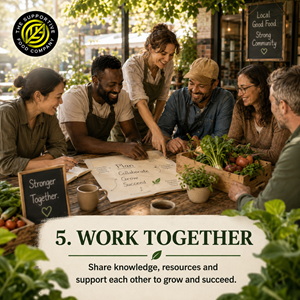 Success points: what makes a community business group work
A business collaboration is more likely to succeed when it has the following features.
1. A clear purpose
Everyone should understand what the group is for.
If the group exists to promote local food businesses, say so. If it exists to support organic producers, say so. If it exists to improve the local high street, say so. If it exists to connect business and community projects, say so.
A vague group attracts vague results.
2. A small first goal
Do not begin by trying to create a national movement, a large conference, a complicated membership scheme, and a perfect website all at once.
Begin with one useful goal.
For example:
- Create a simple online directory.
- Hold one business meetup.
- Organise one local showcase.
- Run one shared social media campaign.
- Produce one local food map.
- Arrange one talk or open day.
- Invite ten businesses to join a pilot project.
Small success builds trust.
3. The right people at the start
A good beginning usually needs a few steady people, not a crowd.
Look for people who are reliable, practical, honest, and able to complete tasks.
Useful strengths include:
- Organisation.
- Communication.
- Local knowledge.
- Business experience.
- Website or design skills.
- Event planning.
- Financial care.
- Food, farming, retail, or community experience.
- Calm conflict handling.
Avoid building the group around people who only want status, attention, or control without doing the work.
4. Clear roles
People should know what they are responsible for.
For example:
- One person manages the website.
- One person handles member enquiries.
- One person keeps financial records.
- One person coordinates events.
- One person manages social media.
- One person checks wording for responsible health or food claims.
- One person liaises with venues or local organisations.
Clear roles reduce confusion.
5. Transparency around money
Money should be handled carefully from the beginning.
Even if the amounts are small, keep records. Record income, spending, donations, sponsorship, advertising, subscriptions, and event costs.
If businesses are paying to be involved, they should understand what they are paying for.
Trust is easier to keep than to rebuild.
6. Fair promotion
Members should know how promotion works.
If some businesses are featured more than others, explain why. If paid sponsorship gives extra visibility, say so. If free listings are available, make the conditions clear. If content is moderated, explain the standards.
Fairness does not always mean everyone gets exactly the same exposure. But it does mean the rules are clear.
7. Useful communication
A good business group communicates simply.
Members do not need endless messages. They need clear updates:
- What is happening?
- What has been decided?
- What help is needed?
- What deadlines are coming?
- What opportunities are available?
- What has been achieved?
Good communication keeps people involved.
8. Practical community value
The group should be useful to the public, not just to its members.
A business collaboration becomes more trusted when it helps customers, residents, visitors, families, carers, producers, and community groups find what they need.
In a Supportive Food-style setting, this may include helping people find local food, responsible wellbeing support, farmers, markets, ethical suppliers, organic shops, cafés, community projects, and educational resources.
Failure points: why business groups collapse
Many business groups do not fail because the idea was bad. They fail because the structure was weak.
Common failure points include:
1. No clear leadership
When nobody has final responsibility, decisions drift. Everyone may have opinions, but nobody takes ownership.
2. Too much committee control
A committee can slow everything down, especially when members are busy business owners with limited time. If every decision needs a meeting, progress becomes painful.
3. Unclear money arrangements
Money confusion quickly damages trust. Groups should never be casual about funds, subscriptions, sponsorship, or expenses.
4. Overpromising
Some groups promise too much too soon. They announce major events, large campaigns, big websites, member benefits, or community projects before they have the capacity to deliver.
It is better to underpromise and build steadily.
5. Personality clashes
Business owners are often strong-minded. That can be useful, but it can also create conflict. Clear rules, calm leadership, and written expectations help prevent disagreements becoming personal.
6. No visible benefit
Members will leave if they see no benefit. That benefit may be promotion, introductions, events, shared learning, community impact, or practical support. But something useful must happen.
7. Lack of public trust
If the group looks self-serving, political, confusing, or exaggerated, the public may not trust it. Trust grows when a group is honest, consistent, useful, and careful with claims.
8. Burnout
A group that relies on one person can collapse when that person becomes tired, ill, busy, or discouraged. Share tasks, but keep authority clear.
A simple starting model
For many community business collaborations, a simple model may work best.
Step 1: Define the purpose
Write one sentence explaining what the group does.
Step 2: Choose the lead person/s or lead organisation
Make it clear who is responsible for the group’s direction, standards, and decisions.
Step 3: Gather a small core team
Choose two to five reliable people with practical skills.
Step 4: Decide the first useful project
Pick one achievable activity, such as a directory page, shared event, local map, business breakfast, producer showcase, or online campaign.
Step 5: Set simple rules
Cover membership, promotion, money, behaviour, decision-making, use of logos, public statements, and responsibility.
Step 6: Communicate clearly
Tell members what is happening and what is expected.
Step 7: Review honestly
After the first activity, ask:
- What worked?
- What did not work?
- Who benefited?
- What was too difficult?
- What should we stop doing?
- What should we do next?
What success might look like
Success does not always mean hundreds of members. A community business group may be succeeding if:
- Local businesses are more visible.
- Customers discover useful shops, producers, and services.
- Farmers and food producers gain new connections.
- Events are well attended and well managed.
- Members feel supported rather than drained.
- Money is handled transparently.
- The public understands the purpose.
- The group avoids exaggerated claims.
- Local organisations begin working together.
- The group completes practical projects instead of only discussing ideas.
- Authority is clear, but members still feel heard.
- The collaboration creates trust.
 Final thoughts
Community business groups can be powerful, but they need clarity.
Good collaboration is not the same as vague togetherness. It is not everyone controlling everything. It is not endless meetings, unclear authority, or committee discussions that slowly drain the energy from good ideas.
The best groups are practical, honest, and well led.
They listen to members, but they do not allow every decision to become a debate. They welcome ideas, but they also know who is responsible for action. They support businesses, but they also serve the wider community. They are friendly, but not careless. They are open, but not disorganised.
Start small. Choose the right people. Keep the purpose clear. Set fair rules. Be transparent with money. Avoid overpromising. Do useful things. Review honestly.
A strong community business group can help local businesses become more visible, more connected, and more trusted. And when businesses collaborate well, communities can benefit too.