
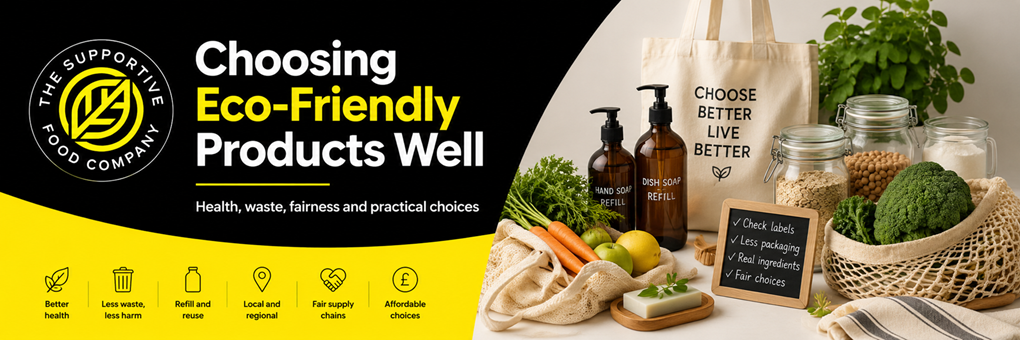
The label says green, the packaging is a soft beige, and a leaf on the front hints at nature or care. But for many people trying to make better choices, the uneasy question remains: better for whom? Talking about eco-friendly products isn’t just about carbon, compostability, or whether a bottle can be recycled…
It’s also about farm resilience, public health, chemical exposure, waste, affordability, and fair treatment for those producing our food and essentials. For families dealing with illness, carers avoiding harmful ingredients, and communities already priced out of healthy options, these questions matter a lot.
What eco-friendly products should really mean
At their best, eco-friendly products reduce harm across the whole chain. That means how something is grown or made, how far it travels, what it is wrapped in, how long it lasts, and what happens when it is thrown away. A product cannot be meaningfully sustainable if it protects one part of the system while burdening another.
That is where the conversation often gets flattened. A reusable item may look like the obvious winner, but if it is poorly made, impossible to clean properly or destined for landfill within months, the claim starts to wobble. A food product may use recyclable packaging but come from depleted soil, underpaid labour or a production model that pushes out small growers. Eco-friendly should never be reduced to a tidy marketing signal.
For a values-led household, a better question is this: does this product support long-term human and environmental wellbeing, or does it merely look the part?
Eco-friendly products in food and home life
For this audience, the most immediate decisions tend to sit around food, storage, cleaning and personal care. These are not fringe lifestyle choices. They shape daily exposure, household budgets and the wider food system.
In food, genuinely lower-impact choices often begin with fewer highly processed items, less unnecessary packaging and more support for local or regional producers where possible. Seasonal produce, minimally packaged staples, refill options and whole ingredients usually do more good than buying expensive branded alternatives sold as ethical. That does not mean everyone must shop at a farm gate or specialist market. It means looking past the shiny language and asking whether the basics are being done well.
At home, the same principle applies. A concentrated washing-up liquid in a refillable container may be more useful than a cupboard full of fashionable “green” sprays. Durable glass storage can reduce repeat plastic use, but only if it suits the pace and realities of family life. For someone juggling treatment appointments, fatigue or care responsibilities, convenience matters. There is no justice in promoting options that only work for people with ample time, money and energy.
Health needs change the calculation
People living with cancer, respiratory conditions, allergies, hormone-related concerns or chemical sensitivities may need to be especially careful with fragranced products, harsh cleaning agents and unnecessary additives. In those cases, the most eco-friendly option is not always the one with the trendiest credentials. It may simply be the one with fewer irritants, fewer ingredients and less avoidable toxicity.
This is why environmental and health conversations should not be split apart. Cleaner production, lower chemical load and more transparent ingredients can support both planetary and personal wellbeing. That overlap is too often ignored.
How to judge eco-friendly products without falling for greenwash
Marketing has become highly skilled at borrowing the language of care. Words such as natural, conscious, clean and earth-kind can sound reassuring while meaning very little. The answer is not cynicism, but steadier scrutiny.
Start with the material facts. What is the product made from? Can it be reused, repaired, refilled or recycled in your local area? Is the packaging excessive? Does the company explain sourcing in plain language, or hide behind vague claims? If food is involved, is there any indication of farming practice, soil care, animal welfare or support for smaller producers?
Then think about scale and frequency. An item used every day deserves more attention than an occasional purchase. Improving one regular household staple can have more impact than buying a premium ethical novelty once in a while. If your family gets through a large volume of packaged snacks, milk alternatives, cleaning supplies or toiletries, those are sensible places to begin.
Certifications can help, but they are not a moral shortcut. Some are rigorous, some are narrow, and some say little about wages, community benefit or nutritional value. A symbol can be useful evidence, not a substitute for thought.
The affordability question is real
Many people are told to consume their way to a better world while facing rising food bills and stretched health costs. That is not a fair burden to place on individuals. The responsibility for safer, lower-waste, more ethical products should not sit only with those who can afford premium prices.
Still, there are practical ways to shift without overspending. Buying less but better works when it replaces repeated waste. Choosing unpackaged or simply packaged basics can be cheaper, not dearer. Cooking from ingredients rather than relying on heavily packaged convenience foods may help, though it depends on time, mobility and energy. Refillable systems can save money in some places and cost more in others. There is no virtue in pretending all sustainable choices are easy.
A fairer system would make the better option the ordinary option. Until then, households are often asked to bridge the gap as best they can.
Why the supply chain matters as much as the shelf
Eco claims often focus on the final product because that is what the customer sees. But harm and value are created much earlier – in fields, factories, transport networks and pricing structures.
If a producer is forced into razor-thin margins, there is little room for soil restoration, better welfare, lower-input growing or decent labour conditions. If independent farmers and ethical small businesses cannot stay viable, the market fills with cheaper products that externalise their true costs onto workers, public health and the environment. That is why supporting better production is not simply a consumer preference. It is part of building a food system that does not punish responsibility.
This matters especially in communities already dealing with poor diet-related health outcomes and reduced access to fresh food. Cheapness at the till can hide much deeper costs elsewhere – depleted land, insecure livelihoods, wasteful packaging, nutritionally weak products and rising pressure on health services.
For that reason, the most useful eco-friendly products are often those rooted in a broader ethic of fairness. They respect land, but they also respect people.
A more grounded way to buy better
The pressure to be perfect can stop people making any change at all. A more realistic approach is to choose a few areas where your household can make steady, repeatable improvements.
Begin with the products you buy most often. Look for fewer ingredients, less plastic, stronger durability and clearer sourcing. Notice what regularly ends up in the bin. Notice what causes irritation, clutter or waste. If a product supports local growers, refill systems, lower-toxicity ingredients or decent transparency, that is a meaningful step.
It also helps to think collectively rather than individually. Sharing bulk buys, swapping surplus garden produce, supporting community food projects and choosing independent producers where possible can spread the benefits beyond one household. The work of change should not rest on isolated consumers making saintly decisions in supermarket aisles. It belongs in communities, institutions and policy as well.
Supportive Food Directory exists because health, farming and fairness are connected. The products we welcome into our homes are part of that story, but they are not the whole story. We also need public systems that make nourishing food accessible, waste reduction practical and ethical production worth sustaining.
Eco-friendly products are only useful if they are honest
A genuinely better product does not need to pretend to save the world on its own. It needs to do its job well, reduce avoidable harm and fit real life. That may look like a refill pouch that actually cuts plastic use, a pantry staple from a trusted local producer, an unscented cleaner that is safer for a vulnerable household, or packaging that has been thoughtfully stripped back rather than cosmetically redesigned.
The strongest choices are rarely the loudest. They are the ones that hold together when you ask hard questions about health, waste, labour, land and access.
If you are trying to buy with conscience, start there. Not with perfection, and not with slogans, but with steady decisions that protect dignity – your own, other people’s and the living systems we all depend on.