
 Download this article as a .pdf file. We do not place a copyright on this type of helpful community resource. Use and share freely.
Go here for Community Business Groups.
Community groups often begin with one simple thought: “something useful could be done here”.
It may be a food-sharing table in a village, a small support group in a café, a weekly market stall, a local gardening project, a national network of volunteers, or an online group connecting people across countries. The size matters less than the purpose. A good community group does not need to start grandly. It needs to start clearly, kindly, and practically.
At its best, a community group creates connection. It helps people meet, share knowledge, support one another, and take small steps that improve daily life. In the Supportive Food world, that might mean connecting consumers, farmers, carers, health professionals, food producers, gardeners, cafés, charities, schools, churches, community centres, or local businesses around a shared interest in better food, better wellbeing, and stronger communities.
The challenge is not usually a lack of good ideas. The challenge is turning those ideas into something realistic, safe, affordable, and sustainable.
Start with the purpose, not the structure
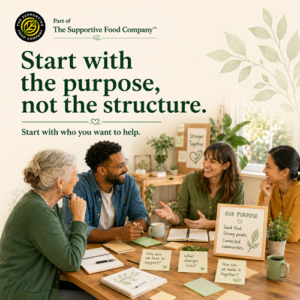
Before choosing a venue, name, committee, website, or logo, ask one important question:
What are we trying to help people do?
For example, a group might aim to:
- Help families find affordable nutritious food locally.
- Support people dealing with illness by sharing responsible food and lifestyle information.
- Connect local farmers and producers with consumers.
- Encourage home growing, allotments, container gardening, or community gardens.
- Reduce food waste by linking surplus food with people who can use it.
- Create social connection for people who feel isolated.
- Support carers with practical local information.
- Help people understand the difference between supportive nutrition and medical treatment.
- Promote local market days, food directories, or community food maps.
- Raise funds for farmers, food banks, medical students, or local support projects.
A group with a clear purpose is easier to explain, easier to support, and easier to keep focused.
A useful test is this: can you explain the group in one sentence?
For example:
“We help local people discover better food, local growers, and practical support for healthier living.” Or: “We connect farmers, consumers, and health-aware community members so good food becomes easier to find and understand.”
If the purpose is clear, the rest becomes much easier.
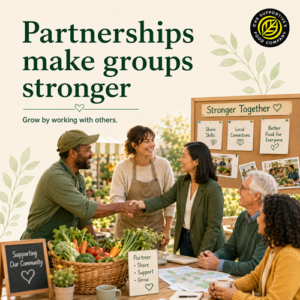
Partnerships make groups stronger
A group does not have to work alone. Useful partners may include:
- Others with the same interest. Network with them.
- Local farmers and growers.
- Markets and farm shops.
- Cafés and restaurants.
- Schools and colleges.
- Health professionals.
- Charities and food banks.
- Faith groups.
- Community centres.
- Local councils or municipalities.
- Environmental groups.
- Gardening clubs.
- Social prescribers or community link workers where available.
- Local media.
- Ethical businesses and sponsors.
Partnerships should be mutual. Ask: what can we help them with, and what can they help the community with?
 Suggestion: obtain as much web presence as you can.
Examples:
- At the Supportive Food Directory we offer free full pages (much more than just links). It’s part of our contribution to all Community Groups – local national or global. Details here. (new tab)
- Become listed in as many free directories as you can.
- Advertise in various places, if your budget allows, such as Google, Bing and Facebook.
- Interlink everything you do on web, cross link all of them. This builds credibility by showing that everything is on the “same page”.
- Post your website across as many social media networks and ask other to share.
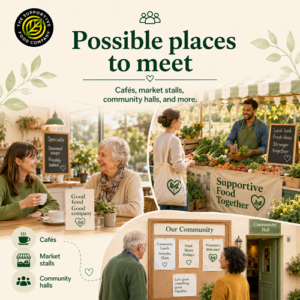
Possible places to meet
There is no perfect venue. The best location depends on the group’s purpose, budget, audience, and practical needs.
1. A café
A café is friendly and low-pressure. It works well for small discussion groups, carers’ meetups, informal planning sessions, or “food and wellbeing” conversations.
The advantages are warmth, informality, drinks, and no need to manage a building. The challenges are noise, limited privacy, cost for attendees, and the need to respect the business owner’s space.
A café works best when the group is small and conversational.
2. A hotel lounge or meeting room
A hotel can work well for slightly more formal meetings, visiting speakers, or local networking events. It can feel professional and comfortable, especially for farmers, food businesses, health professionals, funders, or local organisers.
The challenge is cost. Hotels may charge for rooms, food, equipment, or minimum numbers. They may be better for occasional events than weekly gatherings.
3. A community hall
Community halls, libraries, church halls, school rooms, and village centres are often practical choices. They are usually more affordable than hotels and can handle larger numbers.
They work well for talks, workshops, cooking demonstrations, local food fairs, seed swaps, volunteer briefings, and community meals.
The challenges can include availability, insurance, accessibility, parking, storage, cleaning responsibilities, and safeguarding rules.
4. A market stall
A market stall is excellent for visibility. It allows a group to meet the public, hand out information, promote local producers, collect email sign-ups, and invite people to future meetings.
A stall can also become a “community listening point” where people share what they actually need.
Possible uses include:
- Promoting local organic farmers and producers.
- Sharing simple food education leaflets.
- Signposting to local support services.
- Encouraging people to join a directory or mailing list.
- Displaying seasonal recipes or low-cost healthy meal ideas.
- Collecting donations for a project appeal.
The challenges are weather, stall fees, transport, display materials, volunteer cover, permissions, and the need to avoid making medical claims.
A market stall is often one of the best starting points for public awareness.
5. A small shop or shared space
A permanent shop can be attractive, but it is also a major commitment. Rent, utilities, staffing, insurance, stock, taxes, licences, and opening hours all create pressure.
A safer first step might be a shared shelf, a pop-up corner, or a monthly presence inside an existing shop, café, farm shop, wellness centre, or community hub.
A shop works best when there is already proven demand, committed volunteers or staff, reliable income, and a clear business model.
6. Online first
An online group can begin quickly. It may use Facebook, WhatsApp, email newsletters, Zoom, a website, or a directory listing.
Online groups are useful for national and global connection, but they can become noisy, unfocused, or vulnerable to misinformation. Clear rules matter.
For Supportive Food-style groups, one rule is especially important:
Food and nutrition can support health and wellbeing, but they should not be presented as replacements for medical advice or treatment.
Local, national, or global?
A community group can work at different levels.
A local group is usually the easiest place to begin. It can meet face to face, build trust quickly, and respond to real local needs. A local group might cover one village, town, neighbourhood, faith community, school area, or small region.
A national group can connect regional organisers, share resources, create campaigns, and build a recognisable movement. It needs stronger administration, clearer policies, and better communication systems.
A global group can be powerful, especially where food, farming, poverty, health, and education overlap. But global groups need cultural sensitivity. What works in one country may not work in another. Food costs, medical systems, farming practices, legal rules, and community customs vary greatly. A global group should listen carefully before advising.
A sensible approach is often:
Start local. Share what works. Build regional links, both real life and web. Then expand carefully.
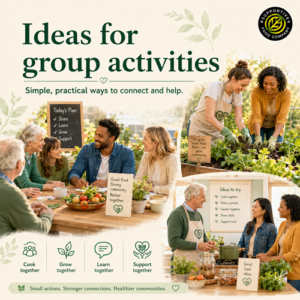
Ideas for group activities
A group does not need to do everything. It is better to do a few things well.
Possible activities include:
Food discovery walks
Visit local farms, markets, allotments, farm shops, orchards, community gardens, or food co-operatives. Help people understand where food comes from and how to buy locally when possible.
Seasonal food tables
Create a simple monthly table showing seasonal produce, basic recipes, storage tips, and low-waste ideas.
Supportive food talks: Invite nutritionists, nurses, doctors, farmers, cooks, gardeners, carers, or people with lived experience to speak. Keep the tone practical and responsible.
Community growing projects; Start with containers, herbs, raised beds, school gardens, or shared allotment spaces. Growing food together builds confidence and connection.
Food access support: Work with existing charities, food banks, community kitchens, faith groups, and local councils to help people find affordable nutritious food.
Farmer and producer showcases: Give local growers and food producers a platform. Help consumers understand who they are buying from and why it matters.
Cooking and confidence sessions: Simple cooking demonstrations can help people who feel overwhelmed by cost, illness, lack of confidence, or confusing health information.
Carer and patient support meetups: These should be gentle, respectful, and clearly non-medical unless qualified professionals are involved. The aim is companionship, signposting, and practical support.
Food waste reduction: Encourage sharing surplus produce, learning storage skills, using leftovers, and connecting with local redistribution schemes.
Community directories: Link to directories for farmers, producers, food charities, community gardens, support groups, cafés, health-aware professionals, and helpful services.
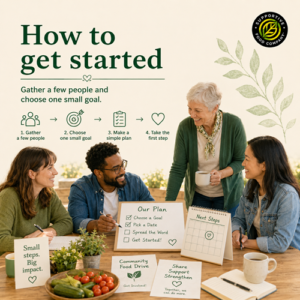
How to get started
Begin small and avoid overcomplication.
Step 1: Gather two to five reliable people
A community group needs more than one enthusiastic person. It needs a small team of steady people who can share responsibility.
Look for people with different strengths:
- A practical organiser.
- A good communicator.
- Someone with local contacts.
- Someone who understands safeguarding or community work.
- Someone with food, farming, nutrition, healthcare, charity, or business experience.
Step 2: Define the first small goal
Do not begin with “change the world.” Begin with something achievable.
For example:
- Hold one local meeting.
- Run one market stall.
- Build one local contact list.
- Visit three local producers.
- Create one information leaflet.
- Organise one food-growing session.
- Start one monthly café meetup.
A small success builds confidence.
Step 3: Choose the simplest venue
Use the venue that creates the least pressure. A café table, library room, church hall, market stall, farm shop corner, or online call may be enough.
Step 4: Create a basic message
People should quickly understand what the group is and is not.
For example:
“We are a community group helping people connect around better food, local producers, supportive nutrition, and practical wellbeing. We do not give medical advice or replace professional care.”
Step 5: Invite people personally
Posters and social media help, but personal invitations are often better. Speak to local farmers, cafés, churches, charities, schools, health workers, community leaders, market organisers, and local businesses.
Step 6: Keep records
Even informal groups should keep basic notes:
- Who attended.
- What was discussed.
- What decisions were made.
- Any money received or spent.
- Any concerns or safeguarding issues.
- Contact permissions for mailing lists.
Good records prevent confusion later.
Real challenges and obstacles
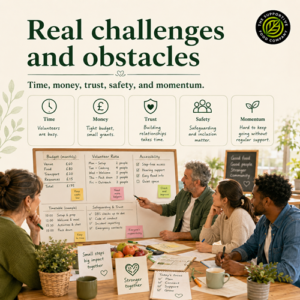
Community work is rewarding, but it is not always easy.
1. Volunteer burnout
Many groups rely too heavily on one or two people. This leads to exhaustion. Share tasks early. Keep expectations realistic. It is better to run one good event per month than five chaotic ones.
2. Money
Even small groups have costs: printing, venue hire, insurance, website fees, stall fees, travel, refreshments, equipment, and storage.
Be honest about costs. Consider donations, sponsorships, small grants, membership contributions, fundraising events, or partnerships with local businesses.
3. Trust
People may be cautious, especially if the group discusses health, illness, food poverty, or money. Trust takes time. Be transparent. Avoid exaggeration. Make it clear who is responsible and what the group can and cannot do.
4. Medical and nutrition claims
This is especially important. Food can be helpful. Good nutrition can support wellbeing. But groups must avoid claiming that foods, supplements, herbs, or diets cure disease or replace treatment.
A safe position is:
Supportive nutrition works alongside appropriate medical care, not instead of it.
When in doubt, signpost people to qualified professionals.
5. Safeguarding
If children, vulnerable adults, patients, isolated people, or people in crisis may be involved, safeguarding matters. Groups may need policies, background checks, clear boundaries, and trained volunteers.
Do not ignore this. Good intentions are not enough.
6. Food safety
If food is prepared, stored, served, or distributed, there may be local food hygiene rules. These vary by country and region. Check requirements before handling food publicly.
This may include allergen information, safe storage, temperature control, labelling, kitchen standards, and insurance.
7. Legal structure
A very informal group may not need much structure at first. But if money is collected, funds are held, events are run, volunteers are managed, or contracts are signed, the group may need a clearer legal setup.
Depending on location, options might include an association, non-profit, charity, community interest company, co-operative, social enterprise, or informal club.
Professional advice may be needed before taking on financial or legal responsibilities.
8. Conflict
Community groups bring together people with different views. Some may be passionate about organic food, others about affordability, others about farming survival, others about medical support, others about environmental issues.
Set respectful rules early. Keep the focus on practical help, not arguments.
9. Accessibility
A good group should consider people who may struggle to attend because of disability, transport, cost, illness, language, caring responsibilities, internet access, or anxiety.
Accessibility is not just about ramps. It is about making people feel able to come.
10. Keeping momentum
The first meeting may be exciting. The fifth meeting may be harder. Momentum comes from clear next steps, useful activities, visible progress, and shared ownership.
Celebrate small wins.
A simple first-month plan
Here is one realistic way to begin.
Week 1: Clarify the idea
Write a one-sentence purpose. Choose two or three people to help. Decide who the group is mainly for.
Week 2: Listen locally
Speak to farmers, cafés, charities, health workers, carers, local businesses, and residents. Ask what is missing and what would actually help.
Week 3: Choose one simple activity
Pick one: a café meetup, a market stall, an online discussion, a community food list, a farm visit, or a small talk.
Week 4: Hold the first event
Keep it friendly and short. Collect contact details only with permission. Ask attendees what they would like next.
After the first event, do not rush. Review what worked, what did not, and who is willing to help.
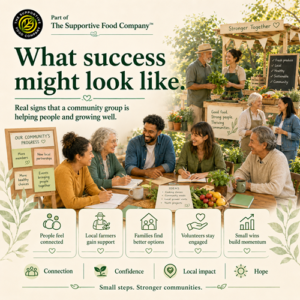 What success might look like
Success does not always mean large numbers.
A group may be succeeding if:
- People feel less isolated.
- Local farmers gain new customers.
- Families discover better food options.
- Patients and carers find responsible support.
- Food waste is reduced.
- People start growing herbs or vegetables.
- Volunteers feel useful rather than overwhelmed.
- Local organisations begin working together.
- The community becomes more informed, more connected, and more hopeful.
Final thoughts
Community groups do not need to be perfect. They need to be honest, useful, and consistent.
Start with people. Listen before building. Keep the purpose clear. Avoid exaggerated claims. Respect medical professionals, farmers, volunteers, carers, and those with lived experience. Work with what is already there. Build slowly.
Whether the first step is a market stall, a café table, a hotel meeting, a church hall, a farm visit, or a simple online group, the heart of it is the same:
People helping people make better connections around food, health, farming, and community.
That is how local ideas become national movements. And sometimes, with care and patience, that is how national movements become global ones.