
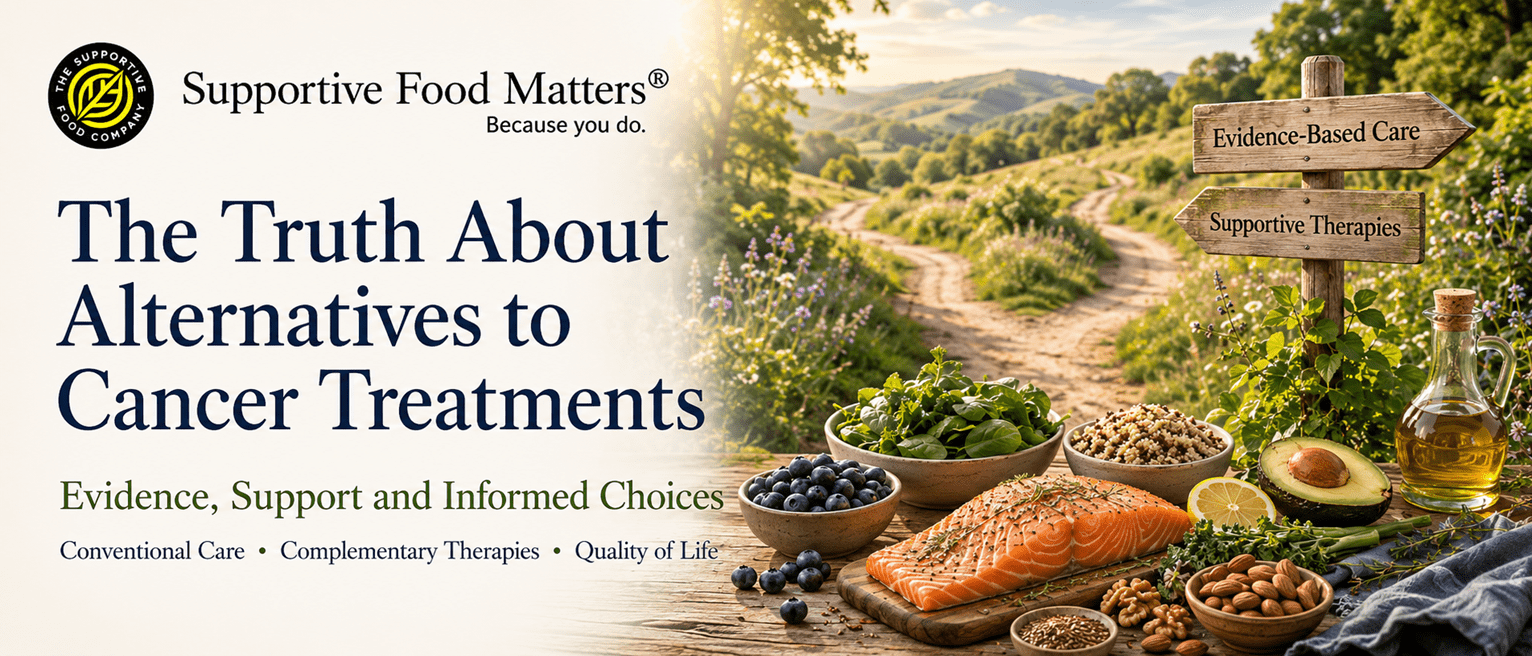
The truth about alternatives to conventional treatments.
We are using Cancer as a prime example here – one of the most contentious issues.
Alternative treatments, when used in place of conventional care, lack scientific proof that they can fully cure cancer. In fact, studies show they can greatly lower survival rates. On the other hand, complementary or supportive therapies are used alongside standard treatments to help ease symptoms and enhance quality of life.
Many diseases can’t be cured entirely (yet!) BUT they can be STOPPED!
 Many have evidence supporting their use in this supportive role. Some prefer to call it “remission”, because one thing is certain; cancer cells exist in all of us. The question is what activates them?
Poor nutrition, injustice, lifestyle are clear factors.
 Alternative Therapies:
The Lack of Evidence and Risks
Alternative therapies are methods promoted as a substitute for standard, evidence-based cancer treatments such as surgery, chemotherapy, and radiotherapy. There is no scientific evidence from rigorous clinical trials that any alternative therapy can cure cancer.
The bottom line? Our simple suggestion: DO BOTH . . . Why?
Survival rates:
Studies have found that patients who choose alternative therapies over conventional care for curable cancers (like breast, lung, or colorectal cancer) have a significantly higher risk of death.
Harmful Delays:
Refusing or delaying proven medical treatment to pursue alternative methods can allow the cancer to progress to an untreatable stage, closing the window for a potential cure.
Potential Harm:
Some alternative therapies can be inherently dangerous (e.g., cyanide poisoning from apricot kernels, or organ damage from other substances) or interfere with conventional medicines.
Financial Exploitation:
Many alternative treatments are expensive, and some are simply money-making schemes that exploit vulnerable patients seeking hope.
Complementary Therapies:
| Natural product | Cancer types mentioned | Food it is found in |
| Apigenin | Breast, Colorectal, Liver, Lung, Prostate, Skin, Gastric, Bone (Osteosarcoma), Sarcoma | Parsley, celery, chamomile, citrus fruits |
| Artemisinin | Breast, Leukemia, Lung, Ovarian, Pancreatic | Sweet wormwood (Artemisia annua) |
| Berberine | Breast, Colorectal, Gastric, Liver, Lung, Ovarian, Prostate | Barberry, Goldenseal, Oregon grape |
| Curcumin | Breast, Colorectal, Gastric, Leukemia, Liver, Lung, Pancreatic, Prostate, Multiple Myeloma, Esophageal/Throat, Ovarian, Endometrial, Non-Hodgkin Lymphoma | Turmeric (Curcuma longa) |
| Emodin | Breast, Colorectal, Liver, Lung, Pancreatic, Islet Cell | Rhubarb, Buckthorn, Aloe vera |
| EGCG | Breast, Colorectal, Liver, Lung, Prostate, Skin, Gastric, Cervical, Nasopharyngeal, Bladder, Kidney, Brain & CNS, Esophageal | Green tea |
| Ginsenosides | Breast, Colorectal, Liver, Lung, Melanoma | Ginseng root |
| Icariin | Breast, Colorectal, Liver, Lung, Prostate | Horny Goat Weed (Epimedium) |
| Resveratrol | Breast, Colorectal, Liver, Lung, Prostate, Skin, Gastric, Melanoma, Nasopharyngeal, Brain & CNS, Non-Hodgkin Lymphoma, Endometrial | Grapes, red wine, blueberries, peanuts |
| Silibinin | Breast, Colorectal, Liver, Lung, Prostate, Skin, Gastric | Milk thistle |
| Triptolide | Breast, Colorectal, Leukemia, Liver, Lung, Pancreatic, Prostate, Brain & CNS, Islet Cell | Thunder God Vine (Tripterygium wilfordii) |
| Ursolic Acid | Breast, Colorectal, Liver, Lung, Melanoma, Prostate, Skin, Cervical, Esophageal, Bladder, Kidney, Bone, Sarcoma, Multiple Myeloma | Apple peels, rosemary, thyme, basil |
A Supportive Role
Complementary therapies are intended to be used with conventional medical treatments to help patients feel better, physically and emotionally. They do not treat the cancer itself but can help manage symptoms, side effects of treatment, and improve overall well-being.
Examples with some evidence for their supportive use include:
- Acupuncture: May help with treatment-related nausea, vomiting, pain, and fatigue.
- Mind-body practices: Meditation, yoga, and relaxation techniques can help manage stress, anxiety, depression, and fatigue.
- Massage therapy: Can provide temporary relief from pain and anxiety.
- Exercise and nutritional counseling: Can help manage fatigue, maintain weight, and improve quality of life.
Key Points
 The medical consensus is that there are no proven “alternatives” to standard cancer treatments that can cure the disease. The best approach is to follow a treatment plan developed by qualified oncologists and discuss any complementary therapies with your healthcare team to ensure they are safe and do not interfere with your primary treatment. You can find evidence-based information on specific therapies from reputable sources:
| Cancer Type | Category of Natural Product (Phytochemical) |
| Bladder | Apigenin, Artemisinin, Berberine, EGCG, Resveratrol, Ursolic Acid |
| Bone (Osteosarcoma) | Apigenin, Berberine, Ursolic Acid |
| Brain & CNS | EGCG, Resveratrol, Triptolide |
| Breast | Apigenin, Artemisinin, Berberine, Curcumin, Emodin, EGCG, Ginsenosides, Icariin, Resveratrol, Silibinin, Triptolide, Ursolic Acid |
| Cervical | Artemisinin, Berberine, Curcumin, Emodin, EGCG, Resveratrol, Ursolic Acid |
| Colorectal | Apigenin, Artemisinin, Berberine, Curcumin, Emodin, EGCG, Ginsenosides, Icariin, Resveratrol, Silibinin, Triptolide, Ursolic Acid |
| Endometrial | Curcumin, Resveratrol |
| Esophageal / Throat | Curcumin, EGCG, Ursolic Acid |
| Gastric | Apigenin, Berberine, Curcumin, Emodin, EGCG, Resveratrol, Silibinin |
| Islet Cell | Emodin, Triptolide |
| Kidney | Berberine, EGCG, Ursolic Acid |
| Leukemia | Artemisinin, Berberine, Curcumin, Emodin, Triptolide |
| Liver | Apigenin, Berberine, Curcumin, Emodin, EGCG, Ginsenosides, Icariin, Resveratrol, Silibinin, Triptolide, Ursolic Acid |
| Lung | Apigenin, Artemisinin, Berberine, Curcumin, Emodin, EGCG, Ginsenosides, Icariin, Resveratrol, Silibinin, Triptolide, Ursolic Acid |
| Melanoma | Apigenin, Berberine, Curcumin, Emodin, Ginsenosides, Resveratrol, Ursolic Acid |
| Multiple Myeloma | Curcumin, Ursolic Acid |
| Nasopharyngeal | Berberine, Curcumin, Emodin, EGCG, Resveratrol |
| Non-Hodgkin Lymphoma | Curcumin, Resveratrol |
| Ovarian | Artemisinin, Berberine, Curcumin, Emodin |
| Pancreatic | Artemisinin, Curcumin, Emodin, Triptolide |
| Prostate | Apigenin, Artemisinin, Berberine, Curcumin, Emodin, EGCG, Icariin, Resveratrol, Silibinin, Triptolide, Ursolic Acid |
| Salivary | Artemisinin |
| Sarcoma | Apigenin, EGCG, Ursolic Acid |
| Skin | Apigenin, Emodin, Resveratrol, Silibinin, Ursolic Acid |
The National Cancer Institute, Cancer Research UK and many other websites.
Home | Food | Facebook | Other sources | Investors | Editors | Contact