
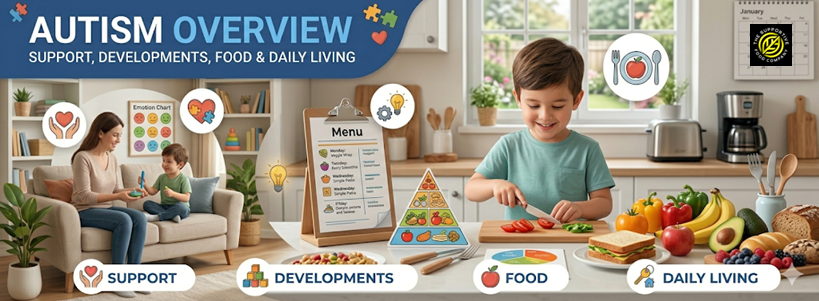
Autism overview: Support, Developments, Food & daily living
Autism is a lifelong neurodevelopmental difference, not an illness or disease, and it doesn’t have a cure. The best support is person-centered, focusing on communication, sensory needs, daily routines, strengths, and any co-occurring physical or mental health needs.
Autistic people are diverse—some may need minimal daily support, while others require regular help with communication, planning, self-care, education, work, eating, or handling overwhelming environments. Effective support works to reduce stress, add predictability, and make daily life easier, rather than trying to “fix” the person.
Food and daily living matter Eating habits, sensory sensitivities, digestive problems, sleep disruptions, executive function challenges, and stress can all impact overall wellbeing. While food isn’t a treatment for autism itself, practical nutrition support can boost comfort, energy, digestion, growth, and confidence at mealtimes.
Key sources used: NHS, NICE, National Autistic Society, British Dietetic Association, WHO and NIMH.
1. Defining autism
Autism affects how a person experiences and responds to communication, social interaction, sensory information, routine, and change. Signs are often present from early childhood, but some people are identified later because the pattern is misunderstood, masked, or only becomes clearer as demands increase.
A simple way to think about the journey
- Possible early or pre-diagnosis patterns: differences in eye contact, play, communication, sensory responses, routines, eating patterns, distress with change, or intense interests.
- School-age, teen, or adult presentation: overload in noisy or unpredictable settings, difficulty reading social situations, exhaustion from masking, reliance on routines, executive-function strain, or burnout.
- Higher-support or more complex situations: limited speech, greater dependence for daily living, co-occurring learning disability, significant sensory distress, sleep difficulties, restrictive eating, anxiety, self-injury, or behaviour that signals unmet needs.
2. Common needs and day-to-day impacts
Autism is often seen only as a social-communication difference, but everyday life is shaped by a broader mix of sensory, practical, emotional, and environmental influences.
| Area | Common features in daily life |
|---|---|
| Communication and interaction | A different communication style, a need for extra processing time, a tendency toward literal interpretation, challenges in reading social cues, or a preference for straightforward language. |
| Sensory profile | Strong reactions to sound, light, touch, smell, taste or movement; shutdown, overwhelm or avoidance in busy environments. |
| Routine and planning | A need for predictability, discomfort with sudden changes, and challenges in shifting tasks can make planning meals, organizing time, or starting activities more difficult. |
| Eating, sleep and body signals | Restricted range of foods, texture sensitivity, irregular eating, constipation, poor sleep, or difficulty noticing hunger, thirst, pain or fatigue. |
| Mental health and co-occurring needs | Anxiety, low mood, ADHD, digestive issues, chronic pain, or behavioral distress often stem from overload or unmet needs. |
| Education, work and daily living | Difficulty with transitions, travel, household tasks, forms, appointments, or workplace demands without reasonable adjustments. |
3. Biological and practical picture
Autism involves differences in how the brain develops and processes information, rather than being a single disease. This is why support needs to be practical, tailored, and flexible, instead of relying on a one-size-fits-all program.
Good practice today emphasizes understanding a person’s unique communication style, sensory needs, strengths, stress triggers, and any co-occurring conditions. When environments are more predictable and communication is clearer, everyday challenges often become much easier to handle.
4. Support and management options
There is no treatment that “cures” autism. Support is usually most useful when it combines practical adjustments, communication support, and proper assessment and treatment for co-occurring conditions.
- Environmental adjustments: Reduce noise, glare, crowding and unpredictability where possible; use quieter spaces, headphones, clear notice of changes, and recovery time after overload.
- Communication support: Use clear language, visual supports, written follow-up, processing time, and speech-and-language input when needed.
- Occupational support: Occupational therapy can help with sensory strategies, self-care routines, home set-up, school access, work tasks and energy management.
- Mental and physical healthcare: Sleep problems, constipation, pain, anxiety, depression, ADHD, epilepsy, or gastrointestinal symptoms should be assessed and treated on their own merits.
- Education and work adjustments: Reasonable adjustments may include predictable schedules, written instructions, reduced sensory load, flexibility around communication style, and a quieter workspace.
- Family and carer support: Families and carers often need information, respite, and practical coaching so support is sustainable.
5. The psychological and daily-life aspect
Autistic people often juggle their own sensory or executive-function challenges alongside dealing with others’ misunderstandings. The strain of masking, adapting to constant change, or pushing through environments that don’t fit can cause exhaustion, burnout, anxiety, or a loss of confidence. Solid support helps preserve dignity, independence, and energy.
1. Food, routine and sensory eating
Food issues in autism are common, but the reasons differ from person to person. The pattern may be driven by sensory sensitivity, predictability, fear of choking or vomiting, past distress, limited interoception, gastrointestinal discomfort, or the need for routine.
What often helps
- Predictable, familiar meals can reduce stress and help someone eat enough consistently.
- Texture matching can make eating safer and more comfortable.
- Meal structure and visual routines can reduce conflict around food.
- Dietitian input can help widen intake carefully when nutrition, growth, weight or energy are affected.
Risks and caution points
- Pressuring, tricking or suddenly changing foods can increase distress and reduce trust.
- Very limited diets may lead to constipation, low energy or nutritional gaps.
- Restrictive diets or supplements should not be used to try to treat the core features of autism.
- Pica, choking fear, significant weight change, dehydration or mealtime panic need professional review.
2. Navigating the consultation
Appointments are often more useful when the practical day-to-day picture is visible. A short written summary can be more helpful than trying to explain everything under pressure.
Your pre-appointment checklist
- Write down the main daily difficulties: eating, sleep, sensory overload, school or work strain, toileting, anxiety, meltdowns, shutdowns, pain or fatigue.
- List any co-occurring diagnoses, medicines, allergies, bowel symptoms, food exclusions or weight concerns.
- Note what helps: routines, quieter times of day, preferred textures, visual schedules, time to process, or alternative ways to communicate.
- Take examples from more than one setting if possible, such as home, school, work or travel.
Questions to ask your clinician or support team
- Are there co-occurring problems we should assess separately, such as sleep issues, constipation, anxiety, ADHD, pain or ARFID-like eating difficulties?
- Would a referral to speech and language therapy, occupational therapy, psychology, dietetics, or a specialist autism team help here?
- What reasonable adjustments should school, college, work or healthcare appointments make?
- How can information be given in a format that is easier to process and remember?
- What are the red flags that should prompt earlier review?
3. Comparison of support approaches
| Approach | Best for… | Key point |
|---|---|---|
| Environmental adjustments | Sensory overload, transitions, appointments, school or work access | Often one of the fastest ways to reduce friction and distress. |
| Speech and language support | Communication differences, understanding, expressive language, social communication | Useful when clarity, comprehension or alternative communication methods are needed. |
| Occupational therapy | Sensory regulation, self-care, routines, home or work tasks | Helps translate needs into practical daily strategies. |
| Dietetic support | Restricted eating, constipation, weight concerns, nutritional gaps | Aims to protect nutrition without turning meals into a constant battle. |
| Mental health support | Anxiety, low mood, trauma, burnout or obsessive distress | Should be adapted to autistic communication and sensory needs. |
| Medication for co-occurring conditions | ADHD, anxiety, depression, sleep or other diagnosed conditions | Not a treatment for core autism traits, but may help specific co-occurring problems. |
A final thought…
Autism isn’t an illness to cure; it’s simply a different way of experiencing the world. The aim isn’t to eliminate autistic traits, but to ease unnecessary challenges and make daily life more manageable.
Food can play a role in providing comfort, consistency, growth, energy, and calmer routines. It’s important—but never a replacement for respectful care, sensible accommodations, and thorough evaluation of any co-occurring needs.
Modular 30-day supportive living plan
This mirrors the practical feel of the Parkinson’s post, but the emphasis is support and daily-life fit rather than any claim to treat autism with diet. Build the month around predictability, sensory safety, hydration, sleep protection and one small change at a time.
1. The “Autism support” shopping list
| Category | Useful staples |
|---|---|
| Reliable staples | Preferred breads, rice, pasta, oats, wraps, cereal, potatoes, crackers or other familiar core foods. |
| Easy proteins | Eggs, yogurt, fortified dairy alternatives, beans, tofu, smooth nut butters, fish fingers, nuggets or other accepted protein foods. |
| Fibre and fluids | Water, milk or fortified alternatives, soups, smoothies, fruit puree pouches, oats, berries, prunes or tolerated vegetables. |
| Sensory-safe produce | Frozen fruit, peeled fruit, crunchy veg, soft cooked veg or blended sauces depending on texture preference. |
| Portable options | Cheese portions, yogurts, cereal bars, plain popcorn, fruit pots or other safe snacks for school, work or travel. |
| Mealtime supports | Favourite cutlery, familiar plates, sectioned trays, straws, lunch boxes, timer, visual menu or shopping checklist. |
2. Small weekly goals
- Week 1: map the current routine – favourite foods, hard foods, best mealtime setting, sleep pattern, bowel pattern and energy crashes.
- Week 2: make one environmental change – quieter meals, better lighting, a visual plan, a fixed snack time, or easier food prep.
- Week 3: strengthen nutrition gently – add one tolerated protein, fluid or fibre source rather than forcing variety all at once.
- Week 4: review what is still blocking daily life – eating, constipation, sleep, anxiety, overload or school/work access – and arrange the right professional help.
Sources reviewed:
- NHS – What is autism? – https://www.nhs.uk/conditions/autism/what-is-autism/
- NHS – Autism – https://www.nhs.uk/conditions/autism/
- NICE – Autism spectrum disorder in adults: diagnosis and management – https://www.nice.org.uk/guidance/cg142/chapter/recommendations
- NICE – Autism spectrum disorder in under 19s: support and management – https://www.nice.org.uk/guidance/cg170/chapter/recommendations
- National Autistic Society – Eating guidance – https://www.autism.org.uk/advice-and-guidance/behaviour/eating/all-audiences
- British Dietetic Association – Autism and diet – https://www.bda.uk.com/resource/autism-diet.html
- World Health Organization – Autism fact sheet – https://www.who.int/news-room/fact-sheets/detail/autism-spectrum-disorders
- National Institute of Mental Health – Autism Spectrum Disorder – https://www.nimh.nih.gov/health/publications/autism-spectrum-disorder