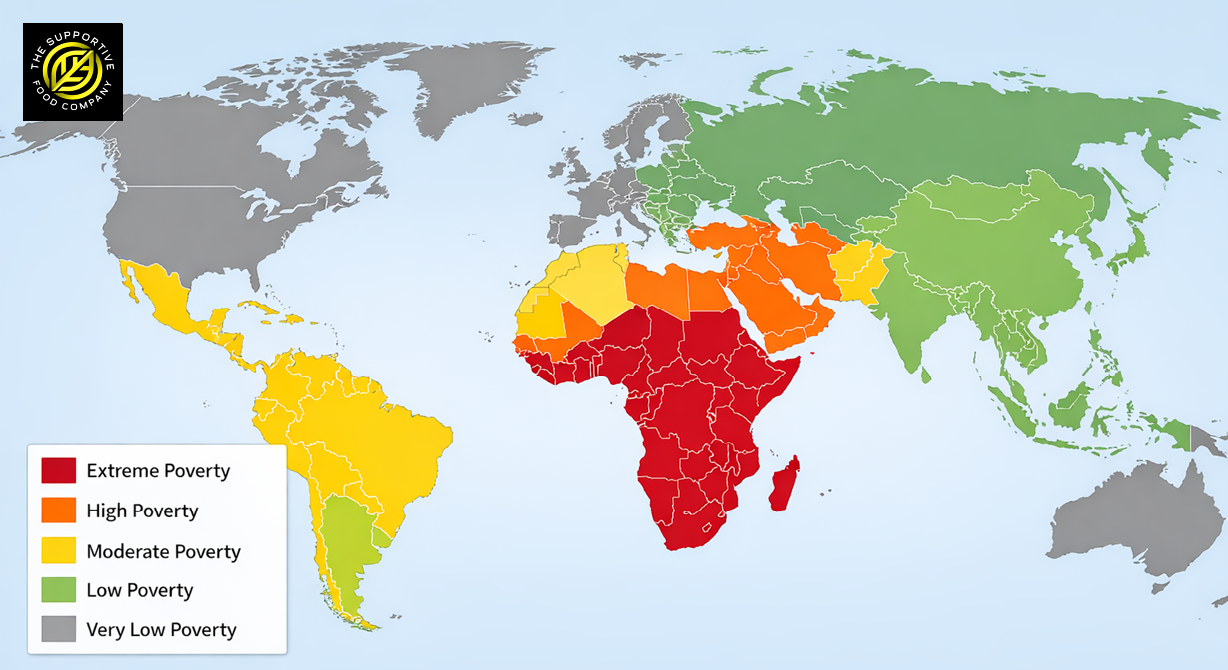
The Most Impoverished Parts of the World
Extreme global poverty is a huge and troubling problem, but looking at the facts and statistics is the first step to understanding how it works and how it can be solved. The World Bank and the United Nations note that, despite major progress in recent decades, overlapping challenges like slow economic growth, pandemic impacts, high national debt, and climate shocks have seriously slowed efforts to reduce poverty.
Here is a breakdown of where extreme poverty (currently defined as living on less than $2.15 a day) is most concentrated today, along with its root causes, preventions, and solutions.
The geography of extreme poverty has shifted significantly over the last few decades. It is now heavily concentrated in specific regions and fragile states.
-
Sub-Saharan Africa: This region currently bears the greatest burden of global poverty. It accounts for roughly 70% of the global population living in extreme poverty. Projections indicate that by 2030, nearly 80% of the world’s extreme poor will live in Sub-Saharan Africa, with a massive concentration in just two countries: Nigeria and the Democratic Republic of Congo.
-
Fragile and Conflict-Affected Situations (FCS): Political instability is playing a bigger role in driving poverty. By 2030, about 60% of people living in extreme poverty around the world are expected to be in countries labeled as fragile or affected by conflict, where institutions struggle and violence is common.
Causes of Extreme Poverty
Poverty is multidimensional; it is rarely just a lack of income, but rather a severe deprivation of basic human needs that creates a trap that is difficult to escape.
-
Conflict and Political Instability: War destroys critical infrastructure, displaces populations, and grinds local economies to a halt.
-
Systemic Inequality: Discrimination based on gender, ethnicity, or social class restricts access to land, resources, and fair wages, cutting off avenues for upward mobility.
-
Climate Change and Environmental Shocks: Extreme weather events disproportionately hit the poorest populations. A natural disaster can wipe out a subsistence farmer’s entire livelihood overnight.
-
Lack of Education: Without basic literacy, numeracy, and skills training, generations remain trapped in low-paying, informal, or precarious labor.
-
Hunger and Malnutrition: Malnutrition weakens immune systems and causes childhood stunting, which severely curtails a child’s lifelong cognitive development and economic potential.
Preventions
Prevention focuses on building resilience so that vulnerable populations do not fall into (or return to) poverty when unavoidable crises hit.
-
Robust Social Protection Systems: Implementing universal safety nets—such as predictable cash transfers, food assistance, and unemployment benefits—prevents temporary economic shocks from permanently devastating families.
-
Climate Adaptation: Developing adaptive agricultural practices, early-warning systems, and resilient infrastructure helps communities withstand natural disasters without losing their livelihoods.
-
Early Healthcare and Sanitation: Providing widespread access to clean drinking water, basic sanitation, and routine childhood immunizations prevents disease outbreaks that drain family resources and lower life expectancies.
-
Disaster Risk Insurance: Expanding access to insurance markets protects low-income households and vulnerable industries from catastrophic financial loss due to crop failure or severe weather.
Solutions
Eradicating poverty requires systemic, long-term investments from both local governments and the international community.
-
Inclusive Economic Growth: Creating decent, well-paying jobs and ensuring fair labor practices across supply chains allows people to earn their way out of poverty.
-
Investment in Human Capital: Building schools, training teachers, and making healthcare universally accessible are historically the most proven pathways to lifting entire nations out of poverty.
-
Empowering Women and Girls: Ensuring girls stay in school and women have equal economic, civic, and reproductive rights drastically improves the financial stability and health of entire families.
International Debt Relief: Many low-income nations currently spend more on servicing international debt than on domestic education or healthcare. Restructuring or forgiving this debt frees up crucial capital for public services.
Highest-poverty hotspots
- South Sudan — This is one of the most extreme situations. According to the World Bank, about 91% of the population is expected to live on less than $3 a day by 2025, and 80% were already below the national poverty line in the latest 2022 household survey. The main causes are ongoing conflict, climate disasters, disease outbreaks, and a fragile economy. Key solutions include establishing peace, improving humanitarian access, building resilience to floods and droughts, expanding market access, and providing emergency cash and food aid.
- Democratic Republic of the Congo — 85.3% below $3/day; its poverty brief says the latest national survey put poverty at 56.2% and estimated the country had almost 50 million extreme poor in 2023. Poverty stays high because growth has not translated into broad welfare gains, conflict persists, inequality is high, and rapid population growth keeps the number of poor rising. The strongest levers are security, roads and electricity, farm productivity, and basic services plus social protection.
- Mozambique — In 2022, 81.4% of people lived on less than $3 a day, and the 2025 Macro Poverty Outlook still projects poverty at around 81%. This is largely linked to a fragile economy, stark rural-urban inequality, and limited access to basic services in rural areas. Key strategies include improving rural infrastructure, expanding basic services, promoting climate-resilient agriculture, and building shock-responsive social protection systems.
- Malawi — 75.4% of Malawians live below $3/day. Poverty is mostly rural: 79% of the rural population lives below the international poverty line, and most poor households are in low-productivity subsistence farming; high food-price inflation has also deepened hardship. The most useful responses are raising agricultural productivity, stabilizing prices, improving nutrition and services, and helping households diversify incomes.
- Burundi — 74.2% below $3/day in 2020. Its poverty brief says poverty reduction has been elusive since the 2015 socio-political crisis, with real per-capita GDP contracting for years after that shock. The priorities here are political stability, more productive agriculture, basic services, and safety nets.
- Central African Republic — 71.6% below $3/day in 2021. World Bank analysis describes CAR as trapped in poverty and fragility despite natural-resource wealth, with conflict and repeated shocks undermining incomes and services. The most important solutions are security, better governance, local infrastructure, basic services, and transparent management of resource wealth.
- Madagascar — 69.2% were below $3/day in 2021. According to UN analysis, poverty is largely a rural issue, fueled by low farm productivity, informality, and long-term neglect of infrastructure and public services. The World Bank also points to extremely low productivity. Key solutions include improving rural roads, boosting agricultural output, expanding basic services, and strengthening climate resilience.
- Niger — 60.5% below $3/day in 2021. Its brief says poverty has been largely stagnant, while other World Bank analysis points to an agriculture-dependent economy, heavy climate vulnerability, and very fast population growth. The most useful interventions are climate-resilient agriculture, irrigation, education and health access, and income growth outside low-productivity farming.
Very large poverty-burden countries
- Nigeria — Nigeria’s poverty rate is lower than some of the countries above, but its scale makes it globally decisive. The World Bank says 41.8% of Nigerians lived below $3/day in 2022/23, with a huge regional gap: 57.4% in the north versus 21.2% in the south. A World Bank note also says Nigeria and the DRC together are expected to account for a very large share of the world’s extreme poor. The clearest priorities are protecting the poor from inflation, creating more productive jobs, and improving security and services in poorer regions.
Major fragile-state cases outside Sub-Saharan Africa
- Afghanistan — 48.3% in Spring 2023. Rural areas benefited somewhat from better harvests and improved market access, but urban poverty remained high because informal workers were hit hard and quality jobs are scarce. The strongest levers are livelihoods, basic services, market access, and stabilization support for vulnerable households.
- Yemen — 33.3% below $3/day, but the latest directly reported national poverty figure is older: 48.6% in 2014. Since then, the World Bank says Yemen’s economy has remained under severe strain from persistent conflict, institutional fragmentation, inflation, and declining aid. The biggest needs are ceasefire and stability, restoration of salaries and core services, food and health support, and macroeconomic stabilization.
The worst case in Latin America and the Caribbean
- Haiti — Haiti is the clearest poverty hotspot in the Americas. The World Bank says 40.4% of Haitians lived below $3/day in the latest official household-survey year, and that this is the highest level in Latin America and the Caribbean. It also says poverty reduction is held back by recurrent natural disasters, insecurity/conflict, weak job creation, and low access to basic services. The priorities are security, jobs, urban services, disaster resilience, and cash support for vulnerable households.
A special case: extreme deprivation driven by war
- Sudan — Sudan is hard to rank with standard poverty data because the war has broken the normal measurement system, but in humanitarian terms it is one of the worst cases on earth. Recent UN and World Bank reporting says over 24.6 million people face acute food insecurity, more than 30 million need humanitarian assistance, and the country is facing one of the world’s worst hunger and displacement crises. The solution is first and foremost ending the war, then restoring humanitarian access, food systems, health services, and livelihoods.
What these countries have in common
Across almost all of these countries, the same pattern shows up: conflict or fragility, weak basic services, rural low-productivity agriculture, climate shocks, inflation or economic instability, and rapid population growth. At the global level, the World Bank says poverty falls fastest when countries create more and better jobs and invest in education, infrastructure, and basic services, while the 2025 social-protection report stresses expanding coverage, making support adequate, building shock-proof systems, and financing them sustainably. UNDP’s 2025 MPI also shows poverty and climate hazards heavily overlap.
The strongest poverty-reduction package is usually:
- peace and basic state capacity
- cash transfers and social protection
- better jobs and farm productivity
- health, education, water, sanitation, electricity
- climate resilience and disaster protection
The World Bank says well-designed social protection has high returns, with an estimated $2.50 local multiplier for each $1 transferred to poor families.
Home | Food | Facebook | Other sources | Investors | Editors | Contact